
The documentary opens in the retirement home of the Jewish Community of Milan. It is where Nedo Fiano spent the final years of his life. It is also where he gradually lost his memory. For Ruggero Gabbai, this starting point is more than just a narrative choice. It is also a declaration of intent. The film recounts the life of one of Italy’s most important witnesses of the Holocaust. Fiano was born in Florence in 1925 and died in 2020. His story begins with an absence of memory. From this point, Nedo, the new project by the Milanese director, takes shape. It follows the acclaimed Liliana, which was dedicated to Senator Liliana Segre.
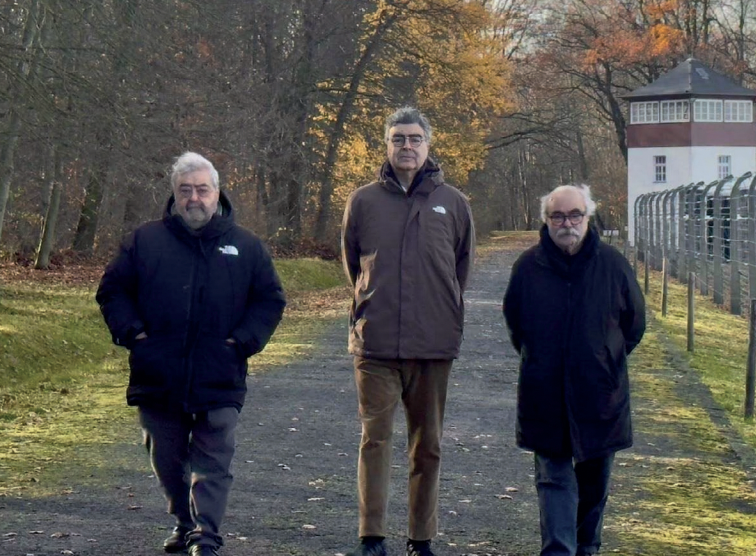
“A witness to history who loses his memory at the end of his life is incredibly powerful,” Gabbai explains. “Perhaps it is also a release from pain. From there, we go back in time and try to recover the Nedo of the past using archival material, including the interview conducted for the documentary Memoria.” The story does not follow classic chronological order. The director makes this clear. Instead, it is constructed as a journey. It is the journey that Fiano undertook across deportation-era Europe. He passed through seven concentration camps. Among them were Auschwitz and Buchenwald, where he was liberated on April 11, 1945. Now, his three sons, Emanuele, Enzo, and Andrea, along with his six grandchildren, are called upon to retrace his steps.
Some parts of the documentary were filmed in Birkenau. There was snow, and it was freezing cold. Yet, his voice was full of energy and capable of conveying both the harshness of the concentration camp experience and a deep empathetic dimension.
The film also gives space to the reflections of his children and grandchildren. This is where the theme of trauma transmission emerges powerfully. “Pain is passed down. There’s no way around it,” Gabbai observes. “The children are all marked by their father’s experience.” At the same time, Nedo managed to transform that pain into a lesson. He was a guiding light in terms of behavior rather than a moral figure, teaching them about civil rights, freedom, responsibility, and building the future. Guidelines that have crossed generations and still shape their view of the world today.”
Fiano’s testimony stands out from those of other survivors. It is deeply personal. “He recounts the facts, yes, but always with a very empathetic tone and less of a technical, chronological approach,” explains the director. “Nedo recounts his journey and the emotions he experienced, including the farewell to his mother, who had understood before him that everything was coming to an end.” This narrative becomes universal precisely because it is rooted in individual experience.
The film is more than just a look at the past. The present enters the story naturally. The context in which the documentary was made—after October 7, a dramatic time for Jews—forms the backdrop to the children’s and grandchildren’s reflections on the present day and contemporary conflicts. “I would never presume to say what Nedo Fiano would think today,” Gabbai clarifies. “But I believe it is important for viewers to consider the time in which this story is being told, a time when the memory of the Holocaust is under attack, being trivialized and distorted.”
The film was made with historical consultation from Marcello Pezzetti. It fits into Gabbai’s years of research on the memory of the Holocaust. “I don’t think I tell the story of the dead,” the director concludes. “I try to tell the story of the survivors and, above all, the values they passed on to us after such a great tragedy. That is what, in my opinion, truly speaks to the present.”
d.r.
Photo: the Fiano brothers (from left, Enzo, Emanuele and Andrea) during the filming of Ruggero Gabbai’s documentary about their father Nedo’s journey through the Europe of deportation.
Translated by Alessia Tivan and revised by Matilde Bortolussi, students at the Advanced School for Interpreters and Translators of the University of Trieste, trainees in the newsroom of the Union of the Italian Jewish Communities – Pagine Ebraiche.