
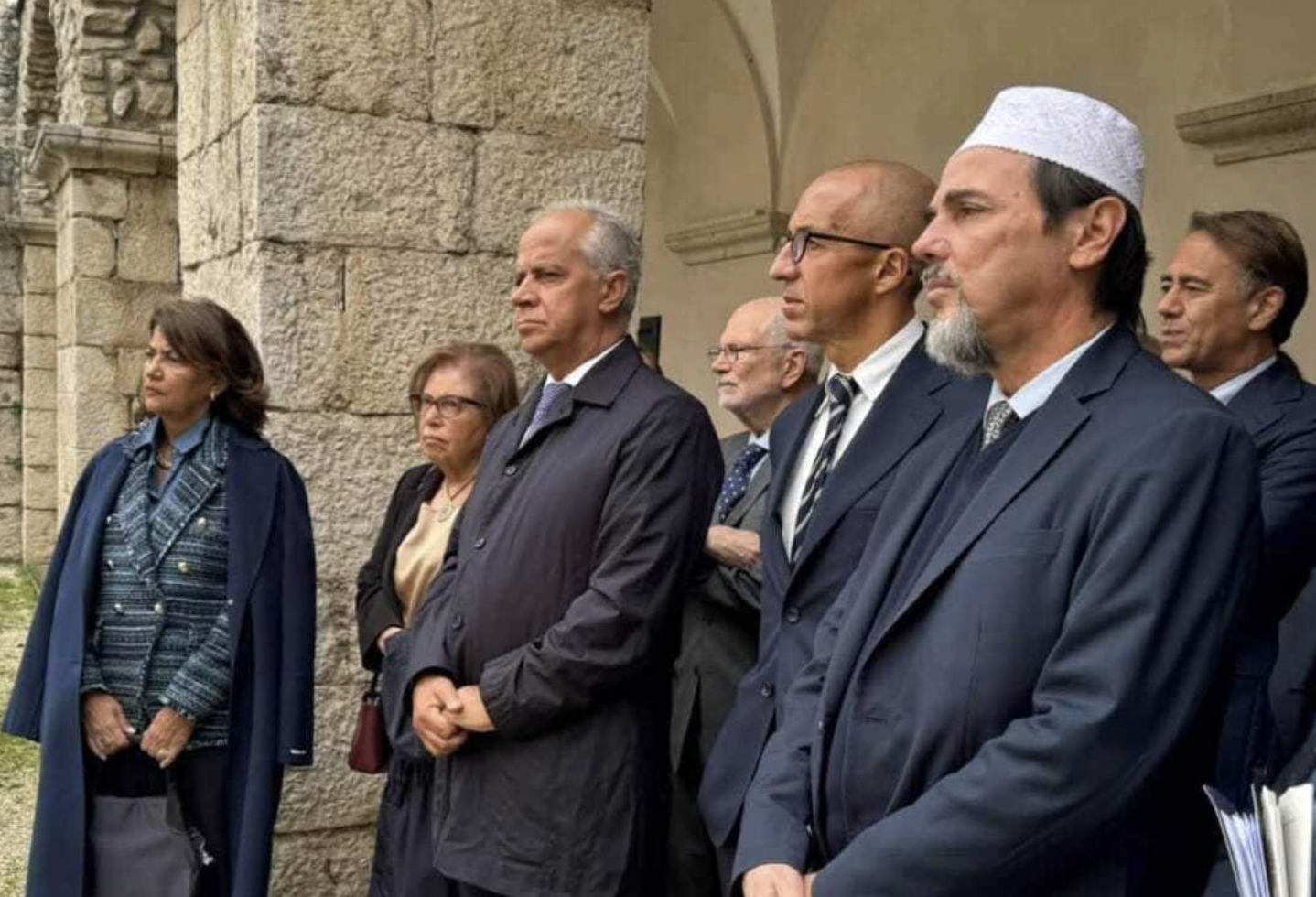
Interior Minister Matteo Piantedosi and several religious leaders attended the launch event for the project, which was conceived by Daniele De Paz, president of the Jewish Community of Bologna. The event took place at the Goleto Abbey rn the province of Avellino, one of Southern Italy’s most fascinating architectural landmarks. The goal of the project is to transform cultural heritage into “a living space open to dialogue, research, participation, and collective growth.” Speakers included the Chief Rabbi of Milan and president of the Italian Rabbinical Assembly, Alfonso Arbib; the president of Coreis, Abu Bakr Alfonso Moretta; the auxiliary bishop of Naples, Gaetano Castello; historian Alberto Melloni; and magistrate Alfonso Pajno. “Civiltà dell’Incontro stems from a simple yet radical conviction,” explained De Paz. “In a world plagued by wars, radicalization, and identity conflicts, dialogue can no longer be merely a moral aspiration. It must become a collective responsibility and, above all, a concrete reality.” In this sense, the president of the Jewish community of Bologna added, meeting one another does not mean becoming the same but rather learning to live together while remaining different. As Rabbi Arbib reminded us, this is to be done “without the presumption of having absolute truths in our pockets.” De Paz then discussed the ambition to “bring to life” a true Citadel of Civilizations because “great cultural transformations have always needed places in which to find their identity.” He clarified that it should not be a museum of religions, a convention center, or a monumental complex intended to host major events occasionally. Rather, it should be “a new type of cultural and social hub, capable of integrating education, research, hospitality, culture, innovation, and daily life.” De Paz noted that the vision outlined at Goleto did not emerge overnight but is “the result of a journey that has brought us here over the years—from the House of Encounter and Dialogue among Religions and Cultures to June 25 of this year, with the signing of the ‘Pact among Religions in Italy—The Italian Path to Dialogue.’”
Piantedosi stated, “We are working toward coexistence that preserves social cohesion.”
The minister explained that pluralism “does not require us to renounce our own convictions, but rather to find a way to reconcile them within a framework of clear rules that are equal for all, beginning with the rejection of violence and the unconditional protection of human dignity.” According to Piantedosi, “It is up to all of us to shape a form of coexistence that preserves social cohesion through recognizing others and fully respecting differences.” De Paz said he was very satisfied with the meeting, the ideas expressed, the government’s support, and the participation of Rabbi Arbib, who came from far away to represent the entire Italian rabbinate. De Paz said this was an important sign. Also present was Paolo Ferrara, the councilor for culture of the Jewish community of Naples, who was recently appointed president of the reconstituted Neapolitan section of the Jewish-Christian Friendship Association.