
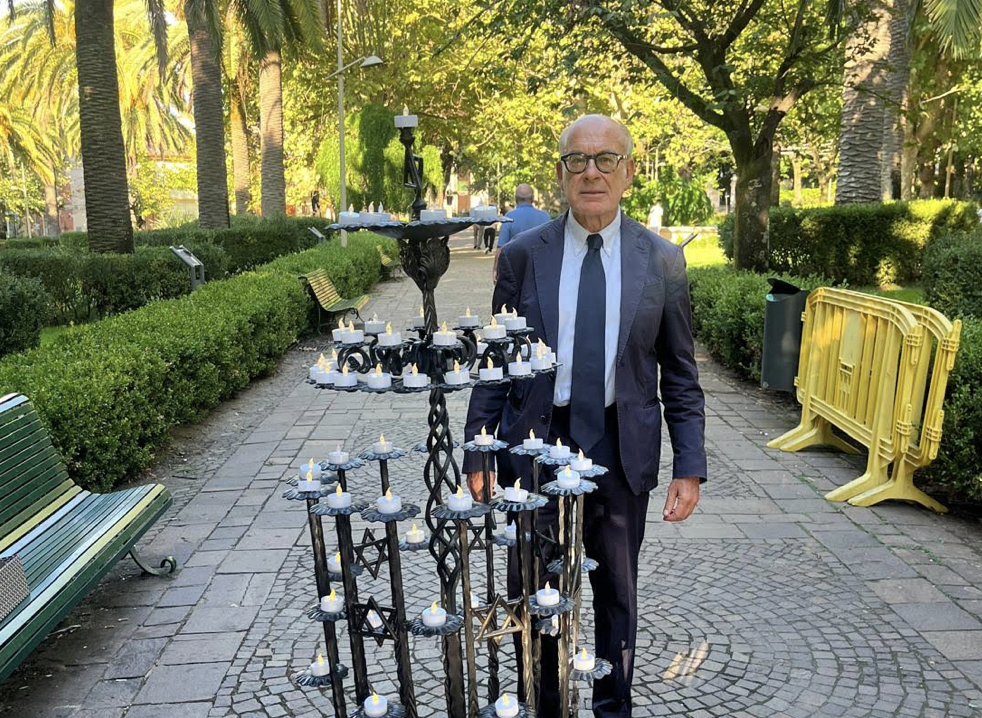
On September 15, a “Civic pact for Dialogue and Against Hate Speech, Racism, and Antisemitism” was signed in the Calabrian municipality of Cittanova by institutions and representatives of religious communities. Supported by the Union of Italian Jewish Communities (UCEI) and the Jewish Community of Naples, the initiative originated locally and was promoted as part of the European Day of Jewish Culture (EDJC).
This year’s theme for the EDJC was love, and love for Judaism, its history, and its values is expressed in the words of Domenica Sorrenti, president of the Cittanova Radici (Cittanova Roots) Association and promoter of the project. “I have a very strong passion for Jewish culture, refined over the years. We live in a time when words of hatred have returned to cause harm. We must all commit to rejecting silence and preventing society from sinking into this downward spiral,” said Sorrenti, a former member of the Cittanova Education Council. She added that words can destroy and create divides.
The Charter of Cittanova, on the other hand, aims to build upon the Italian Constitution, the Universal Declaration of Human Rights, and the remembrance of the Holocaust. “Our roots teach us who we are, and dialogue teaches us to recognize others,” Sorrenti emphasized. “And when it comes to dialogue, here in Cittanova, we know what we’re doing. I was present in 2008 when we dedicated a garden to the Righteous Among the Nations. Judaism is the root, and we must become increasingly aware of it by reconnecting with our history, particularly the expulsion of Jews from southern Italy in 1510. Although there is no longer a Jewish presence in Cittanova, it nevertheless ‘lives on’ in traditions and heritage.”
Open Doors for Further Adhesions
Sorrenti’s appeal was warmly welcomed by Cittanova’s mayor, Domenico Antico “A community grows when it recognizes the dignity of every person as the foundation of being together,” stated the mayor. The document was born from this awareness, along with the desire to consolidate “a coexistence built on dialogue, fraternity, respect for diversity, and religious freedom, in full recognition of the principles of the Constitution.” Antico said, “A charter doesn’t change a community simply because it is signed. It changes a community when those principles become part of people’s everyday words, relationships, and choices.” For this reason, the document will remain open to new signatures from institutions, schools, associations, and citizens.
“The Charter of Cittanova is not just any document,” said Giulio Disegni, coordinator of the UCEI Jewish Southern Italy Project. “What is striking is the choice not to limit itself to enunciating principles, but to evoke the Italian Constitution, the Universal Declaration of Human Rights, and Holocaust remembrance as universal heritage belonging to all humanity, not confined solely to the Jewish community.”
After all, this is the way the Italian Jewish community “has always viewed its role in public life: not as the guardian of a private memory, but as the bearer of a historical experience that concerns everyone because anyone can become a victim or an accomplice of indifference.” Disegni further observed that the signing of the document occurred at a time when antisemitism is reappearing “in both old and new forms” in public discourse and on social media, sometimes “disguised as legitimate opinion.” In this sense, initiatives like Cittanova’s are “a necessary tool in difficult times” because dialogue becomes all the more indispensable and precious “when things get complicated.”
The Rabbi’s Message
In his message, the Chief Rabbi of Naples Cesare Moscati noted that gatherings like the one in Cittanova represent “beacons of hope” and serve as a reminder that true peace is built “day by day, walking together in mutual respect and by valuing what unites us.” Moscati expressed gratitude to the creators of the initiative and to all those involved in the shared commitment “to create a more just and solidary society.”
Roque Pugliese, the representative of the Jewish community in Palmi, Calabria, agreed. “We are happy to have brought together the secular state and various religions and faiths in a single dialogue and purpose. This is a unique event because there was a practical, shared conceptual vision,” he said. Pugliese announced that the charter will now undergo regional development, strengthening the fight against hatred targeting “all diversity” and valuing diversity itself as a shared richness. This is an important aspect that cannot be taken for granted during a time of “ideological narratives” that have weakened the fabric of peaceful coexistence.