
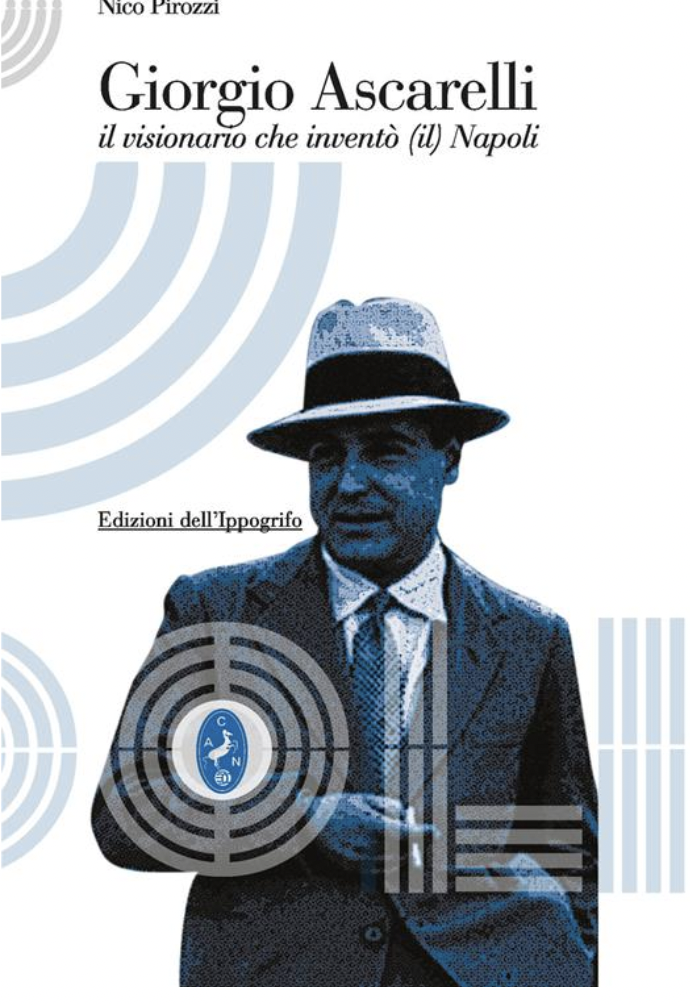
 The “Associazione Calcio Napoli” (now known as SSC Napoli, or simply Napoli) was founded in August 1926 by its first president, Giorgio Ascarelli (1894–1930). Ascarelli was an entrepreneur, philanthropist, and prominent figure in the Neapolitan Jewish community. As the Italian team’s centennial approaches, journalist and historian Nico Pirozzi delves into Ascarelli’s life and legacy in his new book, Giorgio Ascarelli: Il visionario che inventò (il) Napoli (Giorgio Ascarelli: The Visionary Who Invented Napoli), published by L’Ippogrifo. The parenthesis in the title plays with the word “Naples,” which, in Italian, doesn’t require the article when indicating the city but does when referring to the football team.
As the author explains in the introduction, considering Ascarelli exclusively through the filter of football would be reductive. This approach would overlook his esteemed entrepreneurial history of national and international scope, as well as his innate dedication to social justice. Ascarelli was committed to social justice in his company and in Neapolitan society. He distinguished himself as someone who contributed to creating a “new and, in many senses, unedited image” of the city between the 1910s and 1920s.
Pirozzi writes that Ascarelli conveyed his humanism even during the darkest hours of fascism, when he was targeted by the regime. The “subversive” patron of the Naples football team was spied on by the regime for his socialist sympathies and his forward-thinking ideas about welfare, which he developed decades before the entrepreneur Adriano Olivetti.
When Ascarelli died at the young age of 36 in March 1930, thousands of people poured into the streets of Naples to accompany his body to the Jewish cemetery. The stadium he built with his own money was named after him by popular demand, and newspapers praised his everlasting memory. They said no one would forget him. Yet, today, due in part to the posthumous removal of fascism, Ascarelli’s name is foreign to most, whether or not they are football lovers However, Naples cannot afford this oversight. According to Pirozzi, remembering him on the 100th anniversary of the team should not be “only the tribute of an older journalist, but of a distracted and forgetful city.”
Translated by Rebecca Luna Escobar, student at the Advanced School for Interpreters and Translators of the University of Trieste, trainee in the newsroom of the Union of the Italian Jewish Communities — Pagine Ebraiche.