
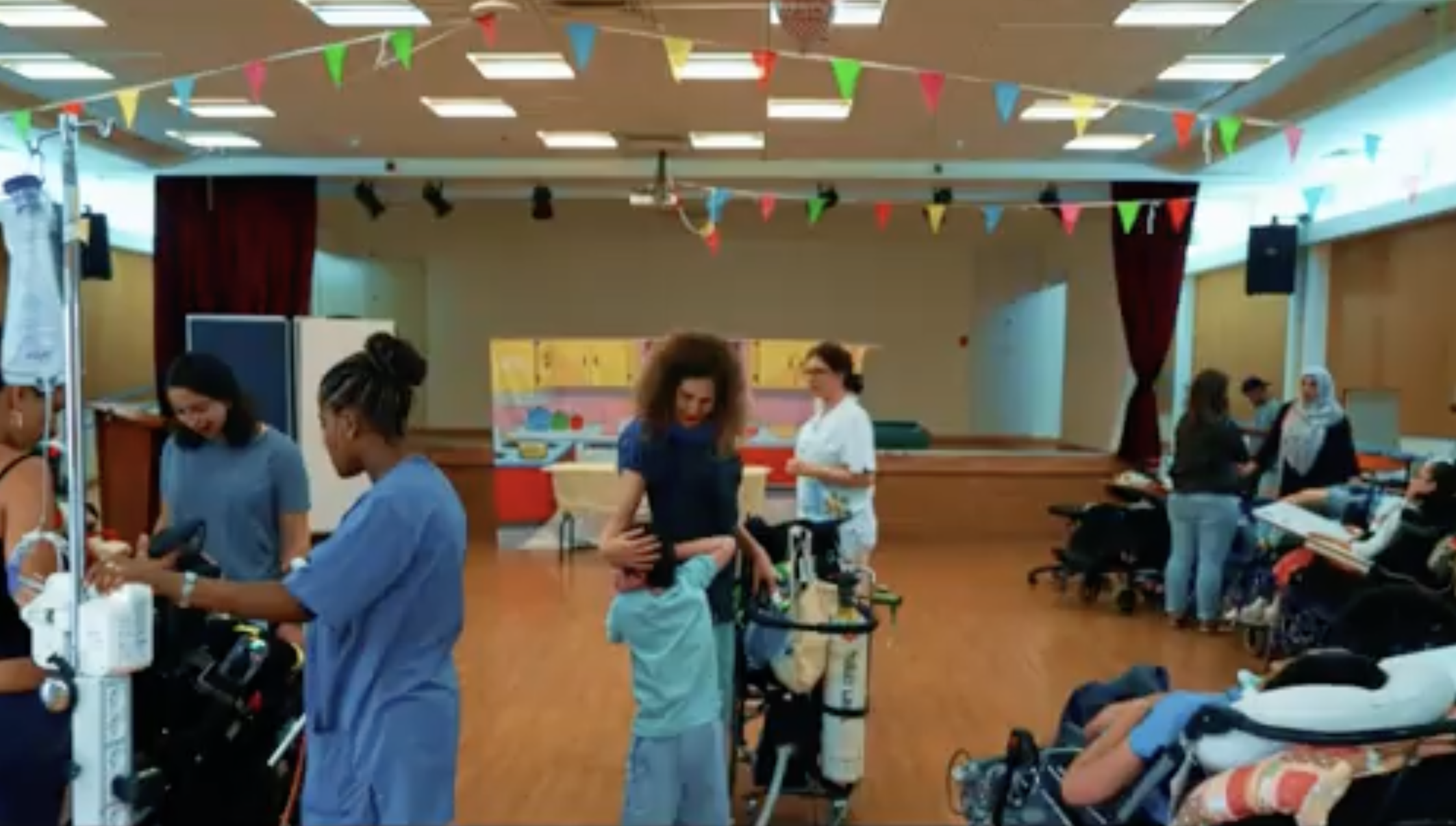
Until about a decade ago, a child in Israel could receive an electric wheelchair around the age of six because it was believed that younger children lacked the necessary skills to operate it. Today, many patients at ALYN, a world-leading pediatric and adolescent rehabilitation facility located in Jerusalem, receive one at age three. This change was made possible by a simulator developed by the Jerusalem hospital’s technological hub. The simulator replicates the experience of driving an electric wheelchair and allows very young children to practice using a joystick in a virtual environment. “We all know that children can use a joystick at three, four, or five years old,” Arie Melamed-Yekel, director of ALYNnovation, explained to Pagine Ebraiche. “So we developed a simulator that teaches younger children how to drive an electric wheelchair. They acquire the necessary skills and can receive one as early as age three.” This gives patients three extra years of autonomy, during which they can explore the world around them instead of depending entirely on adults. “It changes everything: self-esteem, cognitive development, and the ability to relate to others.”
Melamed-Yekel comes from the high-tech world, not medicine. He arrived at ALYN with a conviction shaped by years of work in the industry: No one can go far alone. When applied intelligently to pediatric rehabilitation, technology can redefine the boundaries of what is possible.
“The simplest example is the wheelchair,” says Melamed-Yekel. “If a child learns to use it, they can compensate for the function they have lost. But to do that, training and competence are essential. That is where innovation and the joystick come into play.”
Missile Shelters and Innovation
The recent Iranian attacks and the rush to underground shelters transformed ALYN “into a technological stress-test laboratory,” according to Melamed-Yekel. Remote monitoring systems for vital signs, which are still in the experimental stage, became essential when patients had to be quickly moved into protected areas. “In four and a half weeks of intensive use of these tools, we learned more than we would have in a year.” The system, which was developed by an American company, had originally been designed to monitor each case individually; one machine would sound for one patient and another for someone else. In crowded shelters, however, this approach was unsustainable. This led ALYN to request a display that could immediately show which patient had a problem. “They updated the monitoring systems. That’s how real innovation works: not in the laboratory, but in the field.”
One of the most promising projects is a long-term collaboration with Cognishine, a company that develops gamified cognitive rehabilitation systems for children. The idea is to present exercises in the form of digital games. “If a child wakes up tired, you don’t give them a hundred-piece puzzle; you give them one with fifteen or fifty pieces,” Melamed-Yekel explains. The real breakthrough came with the integration of artificial intelligence, which made this adaptation dynamic and immediate. “Today, we can tell the system: I have a nine-year-old patient who loves basketball and supports this team. Create a specific activity for them.” If the activity becomes too easy the next day, the system makes it more challenging. If the system detects that the child is tired, it simplifies the activity.”
Partnerships with Italy
Melamed-Yekel concluded that all this innovation would not be possible without a strong network of partnerships. In Italy, ALYNnovation has found outstanding partners for this collaboration. For several years, the organization has worked with pediatric hospitals, such as the Eugenio Medea IRCCS Center in Bosisio Parini, Lecco, Lombardy. “Without these synergies, our capacity would be less than one-tenth of what it is today,” he said. He admits that working in partnership is not easy. “But once you understand that this is the right way to move forward, then you build that culture—and you never go back.”
d.r.
Translated by Caterina Mansani and revised by Elizabeth El Khoury, students at the Advanced School for Interpreters and Translators of the University of Trieste, trainees in the newsroom of the Union of the Italian Jewish Communities – Pagine Ebraiche.