
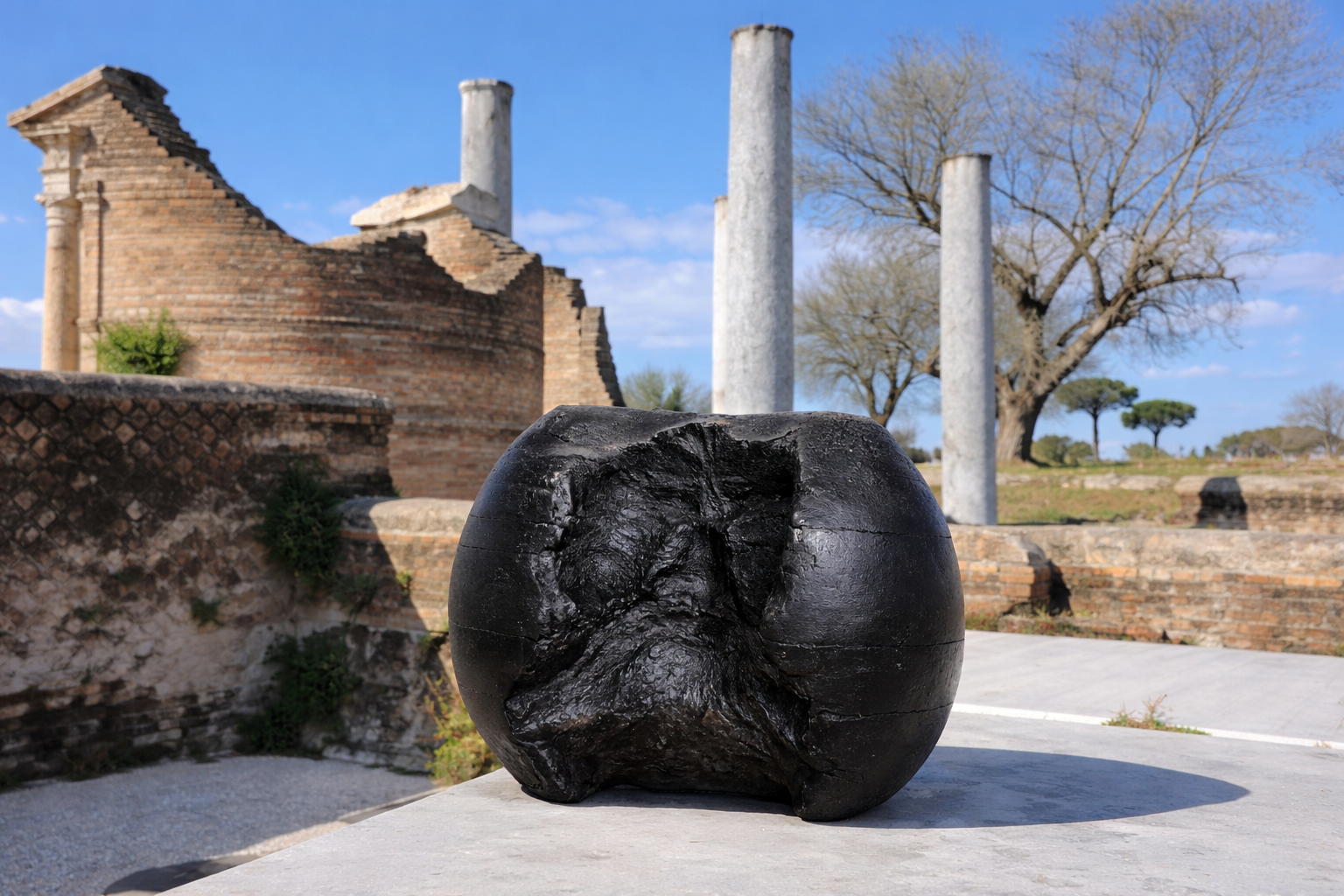
The 12th edition of Arte in Memoria (Art in Memory), a biennial exhibition curated by Adachiara Zevi, opened on May 24 at the ancient synagogue in Ostia, Rome’s antiquity-era port. This year’s edition features contemporary artworks by Ella Littwitz (Israel) and Natalia Romik (Poland). Both artists created site-specific installations that explore themes of remembrance, historical identity, and the search for peace.
Born in 1982, Littwitz is the author of For They Have Seen (Y)our Nakedness. Her work focuses on the space of the Holy Ark of the Ostia synagogue, which was added later to what is considered the oldest synagogue in the Western world. To Littwitz, the Ark appears “foreign” to the site. Although it “attempts to create a connection” with Jerusalem, toward which it is oriented, Littwitz says it also “raises questions about the nature of this ‘center’ and about the possibility of preserving its spirit in today’s world, in light of the events of recent years.”
Littwitz is known for her investigations into the political, social, and cultural landscapes of her country. She denounces a loss of morality yet sees the orientation toward Jerusalem as “a desire for tikkun, a renewed search for belonging and communion with Judaism, Jerusalem, and Israel.” (In Hebrew, tikkun means “repair” or “improvement”. It commonly appears in the phrase tikkun olam, which means “repairing the world”.)
The Polish artist Natalia Romik, born in 1983, presents Flickering Architecture. She developed the project after completing her Ph.D. at the Bartlett School of Architecture at University College London with a dissertation entitled Post-Jewish Architecture of Memory within Former Eastern European Shtetls. The installation consists of a series of black beeswax candles bearing impressions of Warsaw’s ruins after Nazi devastation. It aims to convey “the fragile life of memory, oscillating between erosion and preservation, disappearance and care.” According to Romik, memory survives only through the attention of those who keep it alive, like a flame. “Just as candles slowly melt” while burning, architecture can also vanish, succumbing to “the long, silent, yet inexorable force of oblivion.
Arte in Memoria, which is promoted by the Italian Ministry of Culture and has the Union of Italian Jewish Communities (UCEI) among its patrons, will run until September 27, 2026.
Curator Adachiara Zevi also explores the relationship between art and memory in her new book, Artisti e architetti alla prova dello spazio (Artists and Architects Tested by Space), published by Donzelli. On May 21, the volume was presented at the Metropolitano Urban Center in Rome. It explores “original solutions to the longstanding debate between artists and architects.”
a.s.
Translated by Caterina Mansani and revised by Elizabeth El Khoury, students at the Advanced School for
Interpreters and Translators of the University of Trieste, trainees in the newsroom of the Union of the Italian Jewish Communities – Pagine Ebraiche.