
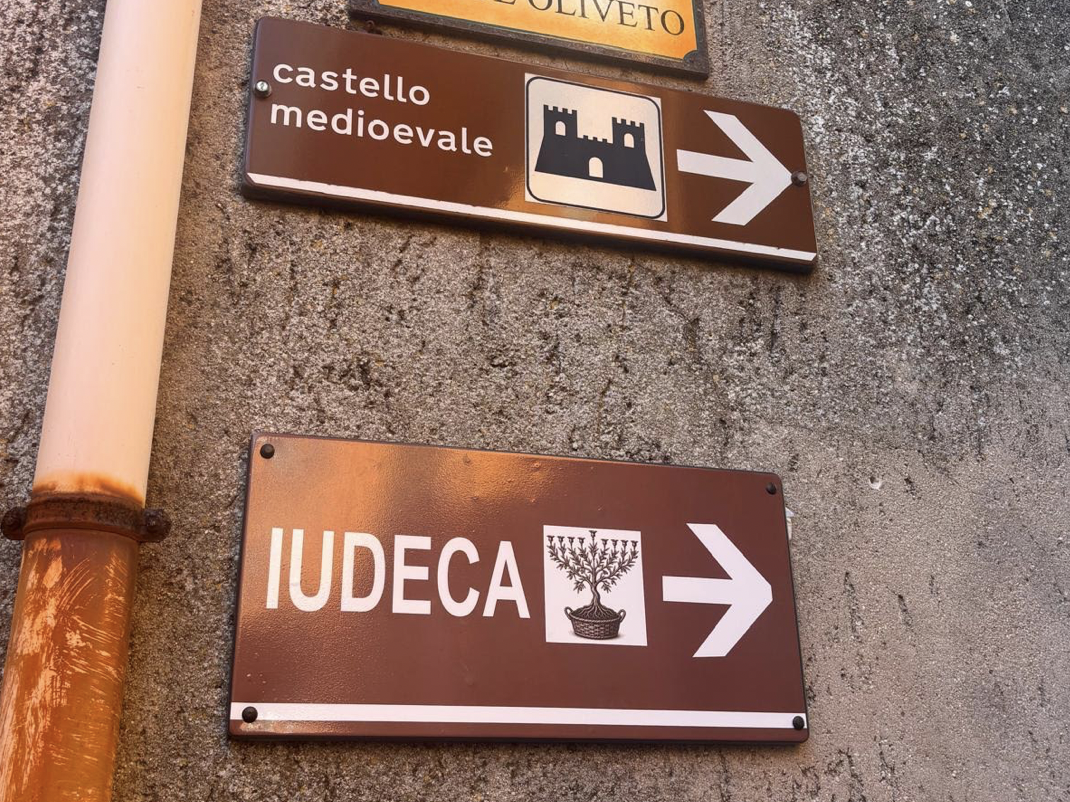
Located within the Aspromonte National Park, San Giorgio Morgeto is one of the most beautiful villages in Calabria. Like many urban settlements in this region, it has an important Jewish past and was affected by the forced expulsion of its Jewish citizens at the beginning of the 16th century. The “Percorso della Iudeca” (Iudeca Route), which was inaugurated on September 16 with a commemorative itinerary and new informational panels, is dedicated to this history, traces of which remain in some local customs.
Following the inaugural walk, a conference was held on the theme “Ahavah—Common Roots,” focusing on the value of research and the enhancement of cultural heritage “as tools for knowledge and dialogue.” A public lighting of a Hanukkiah is also planned for December in celebration of the Jewish Festival of Lights.
“At a time when Jewish memory in Italy often risks being associated solely with the tragedy of the Holocaust, initiatives like this remind us of something fundamental: the Jewish presence in southern Italy has a very long history of over a thousand years,” declared Giulio Disegni, coordinator of the UCEI Jewish Southern Italy Project. “It is a history of exchange, integration, and mutual contribution, as well as expulsion and pain. It is a history that deserves to be studied, told, and known in its entirety, not only in its darkest moments.” Disegni believes that the opening of this route “has a meaning that goes far beyond the borders of this municipality” and “helps reconstruct a map of the southern Jewish presence that has been neglected for too long compared to central and northern Italy.”
Hanukkah Appointment
“We envision this initiative as the start of a journey,” explained San Giorgio Morgeto’s mayor Salvatore Valerioti. “This is also why we created an informational booklet about the history of the Jewish community in San Giorgio Morgeto, to help people understand how its traditions are still alive in our community.”
According to the material, which is based on the research of Professor Cesare Colafemmina—one of the leading scholars of Judaism in Southern Italy who passed away in 2012—life in the Giudecca was “deeply integrated” into the local economy through a “dense network” of craft and agricultural activities.
Michele Fazari is the driving force behind the project. “There have been no Jews in San Giorgio for over 500 years, but some of our peculiarities and habits are still Jewish: covering mirrors during mourning, for example, or spending seven days in close proximity with the family of the deceased, similar to the Jewish tradition of shivah. But Judaism is life above all else, and for this reason, we want to celebrate it at Hanukkah with the final lighting: the moment of greatest light.”