
War and sexual violence, women’s denunciation
“It would be polite to say that Guterres’ statement comes inappropriately late. On the World Children’s Day we already saw how the world was ready to forget the Israeli children killed and abducted in the attacks of October 7. On that occasion, WIZO had begun to denounce the silence on the victims of the terrorist attacks. A silence that on November 25 was bound to also affect the Israeli women who were raped and massacred. At that moment, it would have been appropriate for the entire Jewish world to stand together against indifference. The ADEI WIZO had already published on November 24 a heartfelt statement denouncing that cold conscious forgetfulness, together with an appeal by Anita Friedman, Chairperson WIZO, who together with WIZO federations in the world wrote against the same concepts and the same behaviour still adopted today. But we need to do more in Italy as well. We need to mobilize civil society. It is necessary that Women’s Associations and institutions themselves, with which we have worked for years, take a firm stance. We must no longer tolerate silence.” These are the words of Susanna Sciaky, National President of ADEI WIZO, the Jewish Women’s Association of Italy, one of the federations of the Women’s International Zionist Organization, the apolitical movement born in London in 1920 to give women a voice in the project that would lead to the birth of Israel.
Similar in content but vastly different in tone are the reactions to Guterres’ words coming from women of multiple Italian Jewish communities. The responses come from Rome, Turin, Milan, Genoa, and Trieste. Whether from senior figures in their respective communities, from university professors, or from members who have no formal role, they all shared the same feeling and the wish to remain nameless. They are outraged, disappointed, and very angry. An appeal to feminist associations is giving voice to all the suffering, anger and discomfort.
Sara Levi Sacerdoti, Councilor for Culture of the Jewish community of Turin – together with its president Dario Disegni and the UCEI president Noemi Di Segni, the first signatories – intends first and foremost to break the front of silence: neither international organizations nor feminist associations, with very few exceptions, recognize the violence and humiliation endured by Israeli women on October 7. Because Israeli women were not only massacred, but they were also raped with brutal ferocity, they were humiliated, stripped and paraded like trophies to flaunt. Already dead or still alive, only to be then held hostage. There is still no news about many of them. It was a mass femicide and a war crime.
“Today we loudly ask feminist groups to publicly subscribe to the appeal of the association ‘Paroles de femmes’ that appeared in the Libération newspaper, which demands to recognize that in the attack carried out by Hamas against Israel on October 7, a mass femicide also took place,” reads the appeal. “Two months after the attack, with women and children still in the hands of Hamas and with clear evidence that the horror was premeditated, especially against women, we have not yet heard any feminist association speak publicly, clearly and explicitly in recognition of what happened. We have heard many ‘ifs’ and many ‘buts’, we have heard many calls for equidistance, but no one has spoken clearly for the women raped on October 7, starting with the United Nations.”
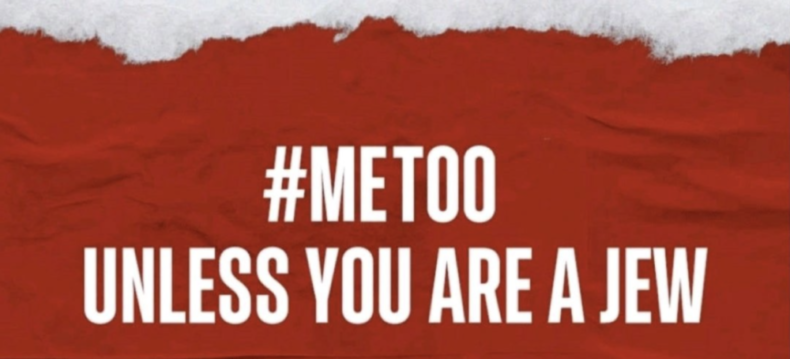
Meanwhile, websites and hashtags have been created to denounce the seriousness of the situation, #metoounlessurajew is just one of the most popular examples. The signatories of the appeal wonder what the future of Jewish women could be like for feminist groups: “Is there no place for them?”. And also: “What credibility does a feminist association have if it does not recognize as an indisputable and unequivocal common factor a mass femicide, perhaps the worst in recent times?”.

Translated by Annadora Zuanel and revised by Francesca Pischedda, students at the Advanced School for Interpreters and Translators of the University of Trieste, interns at the newspaper office of the Union of the Italian Jewish Communities – Pagine Ebraiche.