
Zaka Europe Director: “From Sydney to Crans-Montana, We Return the Deceased Their Names”
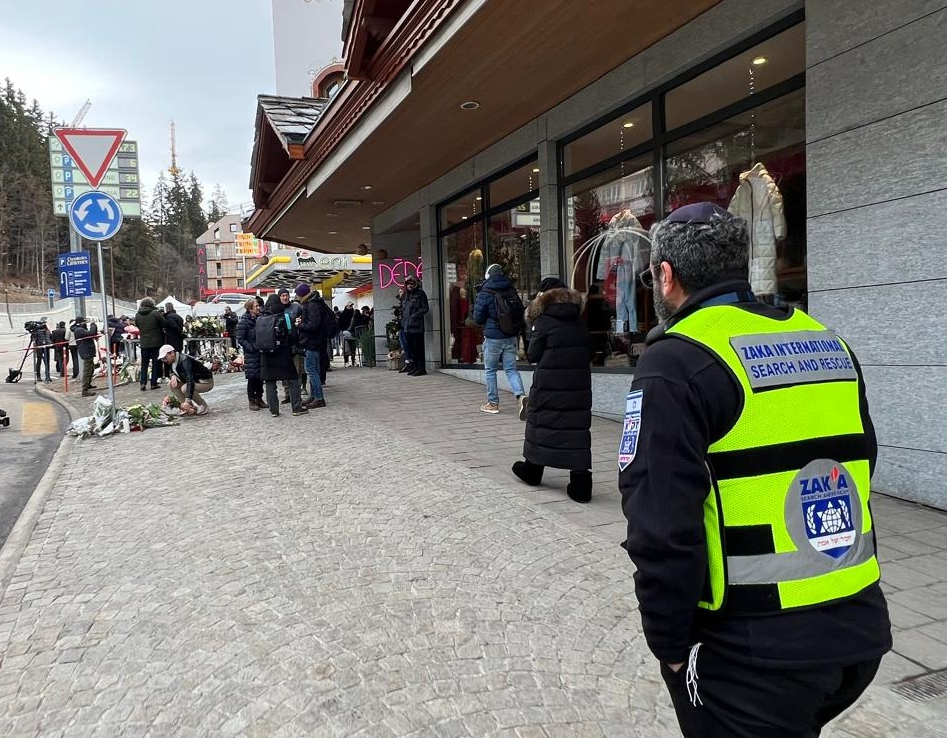
Following the deadly fire in the Swiss ski resort of Crans-Montana on New Year’s Eve, the Israeli disaster victim extraction and rescue organization Zaka dispatched volunteers to assist in the recovery efforts. Members of the local Jewish community also rushed to help. The Chabad movement, located next to the bar where the fire broke out, prepared hundreds of meals for families and individuals waiting for news about their loved ones. Many Zaka volunteers who arrived at the ski resort in Crans-Montana had just returned to Israel from Sydney, Australia, where they had identified victims of the antisemitic attack on Bondi Beach. Others took off from Miami, the UK, and France. Within hours, they were at work, helping the Swiss authorities identify the victims of the fire that killed forty people.
“We immediately realized the gravity of the situation and mobilized our teams,” Hagai Seneor, Zaka Europe director, explained to Pagine Ebraiche. Zaka was founded in 1995 when Israel was struck by frequent terrorist attacks. Its work is rooted in Jewish law and the principle of “kavod hamet,” Hebrew for “respect for the dead.” “According to Halakhah, all of a person’s remains must be buried with them,” said Seneor. “Every fragment, every drop of blood. It is a religious duty and a fundamental human act.”
Over the years, Zaka has developed specific forensic competencies in carefully collecting remains, analyzing bone, dental, and biological fragments, and working in extreme contexts, such as explosions or fires, that may make victims’ bodies unrecognizable. Seneor recounted that, after October 7, Zaka worked tirelessly in areas hit by Hamas massacres, confronting scenes of extreme violence. “Some volunteers still can’t sleep at night. They are still dealing with the consequences of what they saw. Some are receiving professional help, and we are working to open a resilience center to support and rehabilitate all our volunteers,” said Seneor. Nevertheless, he noted that when there is a call, “they are all ready to go because they know that if we do not do it, often nobody will.”
In Crans-Montana, where many victims’ bodies were defaced by burns, Zaka collaborated with the Swiss authorities. “We don’t replace anyone; we always collaborate,” Seneor said, explaining that Zaka never discriminates among victims. “When we arrive at the scene, we never ask who is Jewish and who is not. All human beings are created in the image of God. Our duty is to honor the deceased. This work benefits both the dead and the living. Giving a name to the deceased allows the family to bury them, have a place to cry, and cope with grief.”
Zaka is currently working to open a new branch in Switzerland and is considering Italy as well. Local volunteers enable faster interventions and closer collaboration with the authorities. “We always hope there is no need for us,” Senior concluded. “But if something happens, God forbid, we want to be ready. That is the meaning of our job.”
Daniel Reichel