
October 9, 1982: Rome’s Great Synagogue Attack Investigation Officially Closed
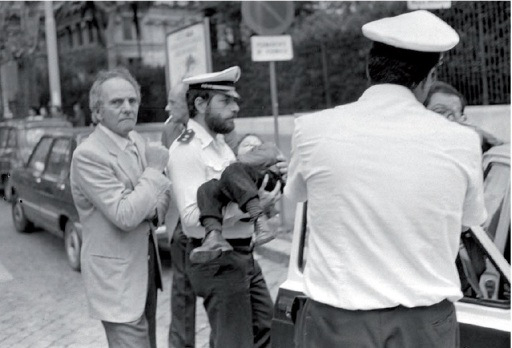
On March 16, the Italian Public Prosecutor’s Office announced the closure of its investigation into the attack on Rome’s Great Synagogue by a commando of Palestinian terrorists 44 years ago. Sandro Di Castro, who was a young cantor at the synagogue and witnessed the attack firsthand, welcomed the decision. “It took them 44 years, but it’s a positive step forward,” he said. “At last, a logical conclusion has been reached. I would like to thank the Public Prosecutor’s Office and the leadership of the Jewish Community of Rome in 2022, who pressed hard for the investigation to be reopened, especially during the conference marking the 40th anniversary.”
Rome magistrates issued notices of the investigation’s conclusion to five individuals believed to be responsible for the October 9, 1982, attack. Two-year-old Stefano Gaj Taché was killed, and more than forty people were injured. According to investigators, the attack was part of the strategy of the organization led by Abu Nidal, a Palestinian terrorist who was active in the 1970s and 1980s. He was also responsible for numerous attacks against Jewish and Western targets.
The Prosecutor’s Office explained that the investigation into the attack on the Great Synagogue revealed links to other terrorist acts carried out during the same period, particularly the 1982 Rue des Rosiers attack in Paris. This suggests the presence of a common, coordinated operational plan.
For Di Castro, the results confirm what was evident from the beginning: “It was unthinkable that such an operation could have been the work of a single person. Between planning, execution, and escape routes, we are talking about dozens of people involved.”
He added that the time that has passed weighs heavily: “These people have lived in peace for 44 years. This does not bring Stefano back to us, nor does it erase the wounds we still carry. However, from a justice standpoint, it is still a result.”
Upon news that the investigation had been closed, the Jewish Community of Rome expressed “bitterness” over how long it had taken. In a statement, it emphasized that the October 9, 1982, attack was “an antisemitic act that struck innocent people at prayer under the pretext of a war being fought elsewhere.”
The community remarked that the judiciary’s action is “an important step in the process of ascertaining the truth” and thanked investigators and institutions for their work, including at the international level. “There remains deep dismay at the time that has passed, and at the wall of omerta, reticence, and obstacles that slowed the full emergence of the truth for decades,” said Victor Fadlun, president of the Jewish Community of Rome. He reiterated the demand that all those responsible be brought to justice: “It is a right of the victims and their families, but it is also a duty of the state.”
He also emphasized that October 9 is not “a closed chapter.” It is “a wound that concerns the entire country,” he said, recalling Italian President Sergio Mattarella’s words about Stefano Gaj Taché: “One of our children, an Italian child.”
Di Castro, who was wounded in the attack, said he has learned to live with that memory, which never stops resurfacing. “When I speak about it to young people, especially in the places where it happened, the emotion always comes back. I don’t have nightmares, but reliving those moments is still very intense.”
There are situations in which that wound reopens: “During commemorations or when we hear news of attacks on synagogues or schools in Israel or other countries. In those cases, inevitably, my mind goes back to that day.”
For him, October 9 is a story he has had to live with. “It is part of the history of the Jewish people, which is marked by painful dates and difficult moments.” However, there is also a positive aspect: our ability to maintain a strong identity and keep moving forward despite everything. This strength allows us to overcome tragedies like that one.”
Daniel Reichel
Translated by Elizabeth El Khoury and revised by Caterina Mansani, students at the Advanced School for Interpreters and Translators of the University of Trieste, trainees in the newsroom of the Union of the Italian Jewish Communities – Pagine Ebraiche.