
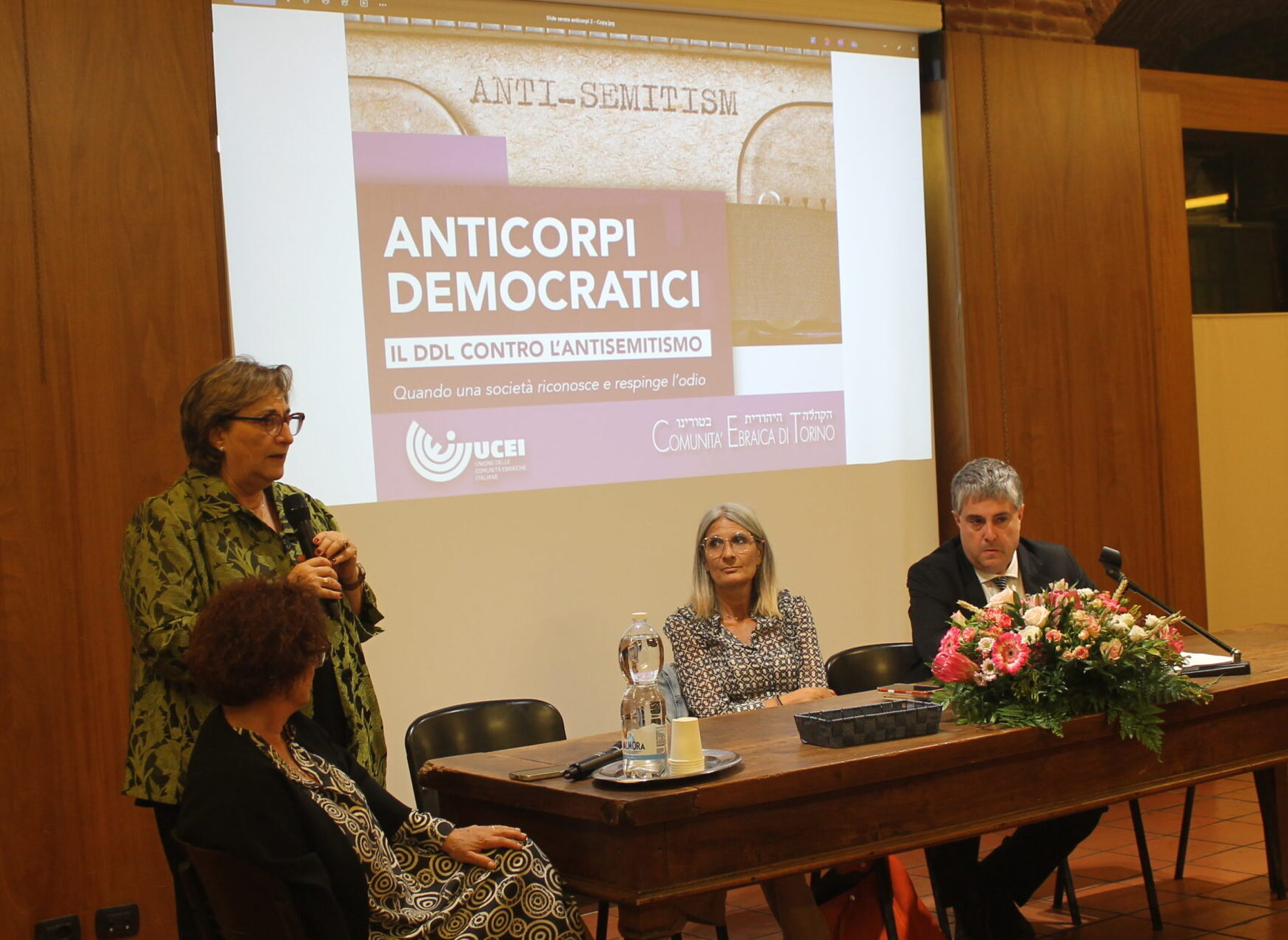
Following its approval in the Senate, the antisemitism bill is now under consideration in the Chamber of Deputies. UCEI President Livia Ottolenghi expressed hope for swift, bipartisan approval. “Our concern and our priority are that the law be passed, period. The existence of a law combating antisemitism would send an extremely important message about the democratic life of this country and its parliament in response to an existing problem that shows no signs of abating,” Ottolenghi reiterated at a May 25 event organized, on May 25, by the UCEI at the Jewish Community of Turin titled “Democratic Antibodies — The Antisemitism Bill: When a Society Recognizes and Rejects Hatred.”
Speakers included Representatives Alessandro Giglio Vigna (Lega), Andrea Orsini (Forza Italia), Piero Fassino (Democratic Party), and Senator Simona Flavia Malpezzi (PD).
“The antisemitism bill faced significant opposition, even initially in the Senate. However, ultimately, a text was approved by a large majority,” noted Dario Disegni, president of the Jewish Community of Turin. He noted that the parliamentarians present “are committed to the bill and fighting for its passage in the Chamber of Deputies”.
Ottolenghi stated that the rise in antisemitism in Italy is concerning and presented data from the CDEC Foundation’s Observatory: “We have seen a 400% increase in certified acts of antisemitism compared to 2022. The threat shows no signs of abating, and the situation is very serious. These manifestations are also translating into actual acts of physical violence.”
The UCEI president explained that the measure focuses primarily on cultural prevention rather than repression. “Having eliminated criminal penalties and sanctions, this law invests in education, training, and prevention activities,” she noted, highlighting the mediation efforts made during the parliamentary review.
“The final wording incorporates many demands. Bans on demonstrations have been removed, and freedom of criticism has been explicitly stated.” This balance, in the promoters’ view, should enable the combat of anti-Jewish hatred without stifling public debate, she emphasized.
However, in the House, the bill could reignite the political debate. Giglio Vigna, a Lega MP and one of the bill’s co-sponsors, emphasized the majority’s desire to swiftly move toward final approval. “For my political group, there is no distinction between anti-Zionism and antisemitism,” he stated.
Fassino insisted on the need to distinguish antisemitism from political criticism of the Israeli government. “Combating antisemitism also means knowing how to distinguish between antisemitic phenomena and legitimate criticism of a sitting government,” said the PD deputy. For him, the automatic identification of Israeli Prime Minister Benjamin Netanyahu, the State of Israel, and Jews is “unacceptable.” “It is surreal that any Jew, wherever they live and whatever their nationality, is considered an accomplice of Netanyahu and is asked to answer for his government’s policies.”
For those attending the meeting, the bill represents a legislative, political, and cultural message to the country. “Antisemitism does not only concern Jews,” Ottolenghi concluded. “It is a problem for democratic society as a whole.”