
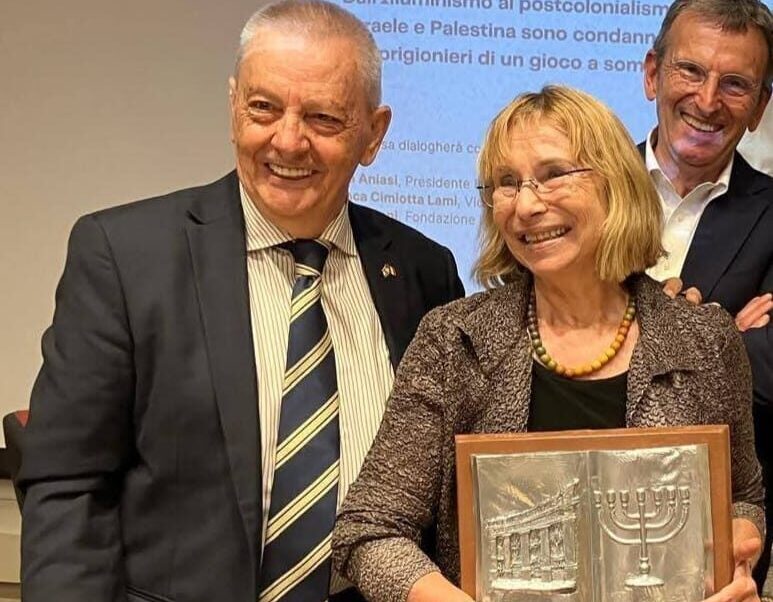
She describes herself as “a daughter of the kibbutz.” Fania Oz-Salzberger is an Israeli historian and professor emerita at the University of Haifa, as well as the daughter of the celebrated Amos Oz. Above all, however, in the opening lines of her lecture in Rome on June 9, when she received the prestigious Italian history award FiuggiStoria Europa Prize 2025, Oz-Salzberger reaffirmed that she is “deeply and unapologetically Zionist.” She then added, “In a way that I will have to explain, because in Israel, there are people who call themselves Zionists, but they are not like me, and I am not like them.”
Family Zionism
To explain her Zionism, Oz-Salzberger began with a family memory set just a short distance from the hall where she spoke. Twenty years ago, she recounted, she took her parents and children on a trip to Italy. At the Colosseum, standing before a wall displaying brochures for tourists, the children called to their grandfather, Amos, “You won’t believe it! There’s even a brochure in Hebrew!” Oz began to cry. “When my children asked why he was crying, he replied, ‘Because Hebrew is still here, while Latin is no longer.’ If you ask me about my sense of history as a Jew and the sense of continuity underlying my Zionism, this anecdote sums it up,” the scholar explained.
She said the Zionism she grew up with was “minimalist” and “very different from certain forms of Zionism today.” “It was not about conquest, superiority, or colonization. It was about having a small place in the world where the Jewish nation could have its own state.” It was a liberal democracy within the ancestral homeland. And an ancestral homeland means there is room for others as well.
This idea, born of the Haskalah (the Jewish Enlightenment), was translated into law through UN Resolution 181 on November 29, 1947, which established two sovereign states, Israel and Palestine, between the Jordan River and the Mediterranean Sea. “My father believed in it all his life. I still believe in it.” One day, a woman asked him why Israelis and Palestinians could not live as one happy family. “My father explained to her, Madam, because we are not ‘one,’ we are not happy, and we are not a family.” The Israeli historian recalled that October 7, 2023, was a tragic demonstration of that reality. “Perhaps one day we will have a single state or a confederation. For now, we need partition.”
The Damages of Post-Colonialism
According to Oz-Salzberger, the Palestinian tragedy, “which is also an Israeli tragedy,” stems from the 1947 decision of Arab leaders who opposed coexistence and partition. The same pattern reappears today in the slogan “From the river to the sea.” “As an Israeli pacifist, I too want to liberate Palestine,” she clarified. “But too many of those demonstrators, like Hamas and Hezbollah, mean something else: you will be dead and I will be free.”
The scholar then turned to postcolonial theory, which, in Western universities, has been “tailored to present Jews as colonizers and Palestinians as their victims.” This argument concerns her personally. “At conferences, people tell me that Zionism is settler colonialism and talk about my grandparents. But my grandparents were not colonizers; they were refugees. “Europe had driven them out.”
The Responsibilities of Edward Said
The scholar then debunked what she called the “falsified quotations” of Theodor Herzl in anti-Zionist academic literature. She also recalled the moment when Edward Said, the father of postcolonial studies, threw a stone toward Israel from the Lebanese border — “an internationally recognized border, not the West Bank or Gaza.” According to Oz-Salzberger, that gesture “gave full permission and passionate approval to violence against Israel. He was telling the Palestinian national movement, ‘You are allowed to use force against Israeli civilians anywhere.’” Said refused to meet Amos Oz. “He had no need to engage in dialogue with a liberal Zionist, an Israeli pacifist. He was playing a zero-sum game. With us.”
Today’s marches against Israel, she argued, are “the simplistic fruit” of postcolonial theory. They deny the historical vulnerability of Jews and Jewish indigeneity in the Land of Israel, treating Israel as “the only country in the world that is not legitimate.”
Internal Criticism
“I must say with shame that many Israeli Jews have also adopted the zero-sum game.” This extremism, she argued, “was born in the euphoria of the Six-Day War,” was fueled by the settlements—”a slap in the face to the two-state solution”—and culminated in the assassination of Yitzhak Rabin. “Likud’s policy has been to strengthen Hamas. If Hamas is strong, we will never be threatened by peace.”
She concluded that the way out lies in inviting the Enlightenment and the virtue of early Zionism, pragmatism, back into the room. “I am not saying that change will happen tomorrow morning, perhaps not even in my generation. But when the Palestinians extend their hand to negotiate, I want Israel to be ready.”
Daniel Reichel
Translated by Caterina Mansani and revised by Elizabeth El Khoury, students at the Advanced School for Interpreters and Translators of the University of Trieste, trainees in the newsroom of the Union of the Italian Jewish Communities – Pagine Ebraiche.