
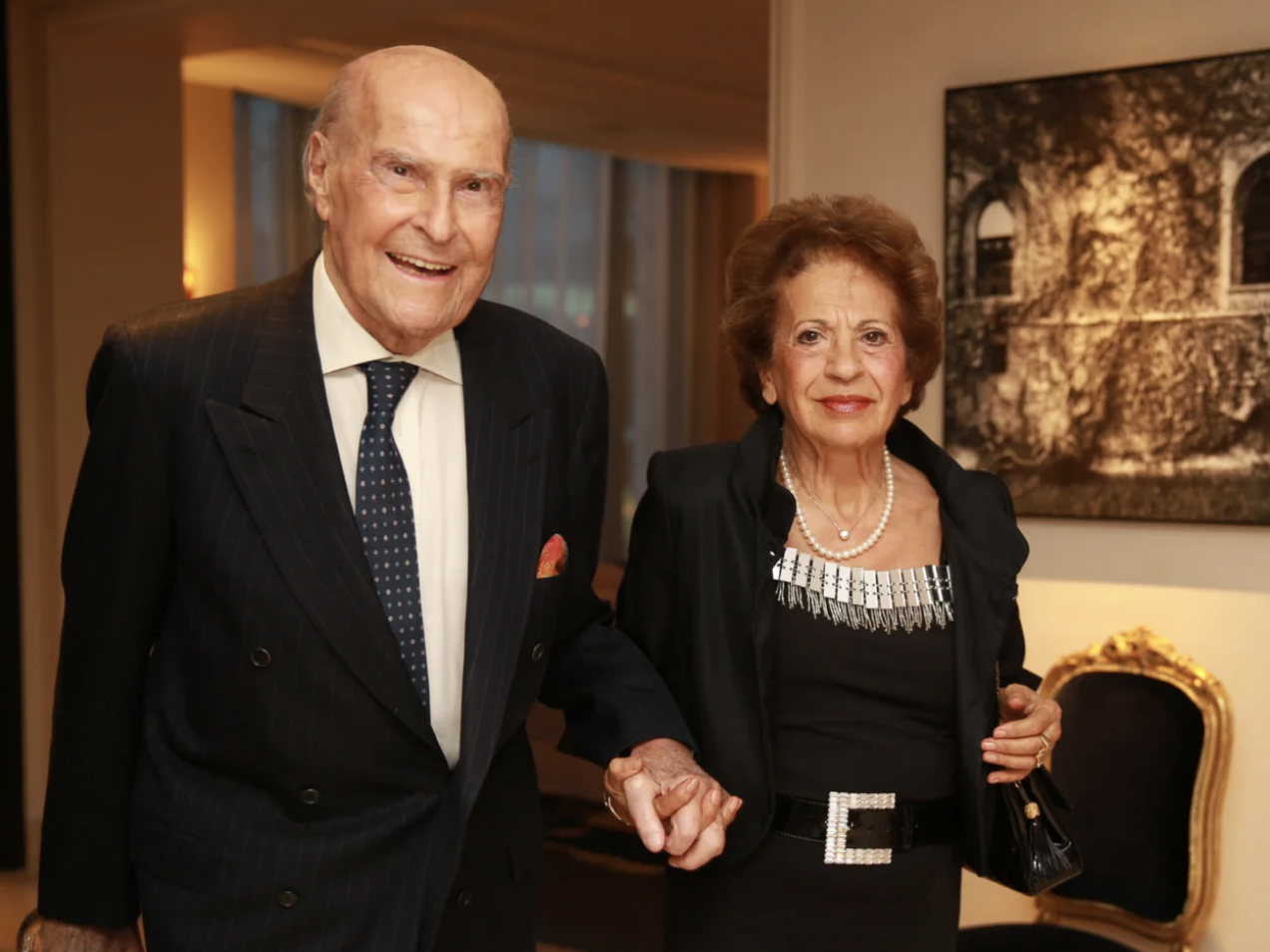
“We would say goodbye every time we parted ways, because we would see these groups passing by and never coming back.” Sultana Razon was elven years old in the Bergen-Belsen concentration camp. There, she was terrified by the showers, a fear that never left her. “They would make us undress, disinfect our clothes, and send us to these big halls. There, we had to wait for what was coming out. In our case, everything went well. It was water.” They never knew if gas would come out of the nozzles instead of water. Sultana Razon told this story in a long testimony recorded by the CDEC Foundation in Milan in 1987. The recurring details in her story were the cold, the daily appeals in the snow “without socks, wearing only clogs,” and the hunger.
Razon passed away on June 11 at the age of 94. The Union of Jewish Communities honored her as a “tireless witness of memory.” “After retiring, she found the strength to share her experience with young people, becoming a precious custodian of memory,” reads a note by the UCEI. “Her life is an extraordinary example of resilience, generosity, and hope. From the wounds of history, she generated care, knowledge, and attention to others.” She transformed the pain she experienced during her deportation to the Ferramonti di Tarsia and Bergen Belsen camps into a life dedicated to caring for others.
Testimony to the CDEC Foundation
In 1987, historian Liliana Picciotto recorded Sultana Razor’s testimony. At the time, Picciotto was researching her book Il Libro della Memoria (The Book of Memory), which lists the names of Italian Jews deported to concentration camps during the Holocaust.
Their Turkish citizenship decided Razons’ destiny, explained Picciotto. “They had Turkish passports, and Turkey was neutral. When the Fossoli camp in Northern Italy was evacuated, the prisoners were deported to Bergen Belsen. This was because Bergen Belsen was not an extermination camp, but a lager, which allowed for the exchange of prisoners with German prisoners. The conditions for the deportees were still very harsh.”
One detail from Sultana’s testimony particularly struck Picciotto: “In Fossoli, before leaving for Germany, her mother took two curtains off the windows and, in one night, sewed clothes for her daughters.” “She knew we had to leave, but we didn’t have enough to wear,” Sultana recalled many years ago. “They didn’t have anything to wear, and their mother took everything she could. It was a tender moment amidst the harshness of those days, and it has stayed with me,” said Picciotto.
The Autobiography
Razon recounted her story in the autobiography Il cuore, se potesse pensare (The Heart, If Only It Could Think), published by Rizzoli in 2013. She was born in Milan on August 24, 1932, to a Sephardic family. Originally from Istanbul, they moved to Italy in 1930. After the racial laws were enacted in 1938, she could not enroll in school. Her old friends pretended not to know her, and antisemitic graffiti marked the walls. One night in Taglio di Po, where her family had been confined, a group of children surrounded her. They shouted, “Go away, go away, dirty Jewess,” and threw stones at her. “The era of terror has begun,” she wrote.
In November 1943, her parents were arrested. The four children were left alone outside the Rovigo prison (Veneto) to beg for soup. “My sister and cousin were only eight years old, and my cousin Leone and I were 11. At one point, the priest of Taglio di Po offered to save the entire family on the condition they would convert. After days of torturing herself, Sultana refused. “How could I betray the religion of my family and my people?”
It was actually an expired Turkish passport that her mother kept in her purse that saved them. In April 1945, the Razons were liberated alongside a hundred compatriots in a prisoner exchange between Berlin and Ankara.
Choosing Pediatrics
Back in Milan in January 1946, Sultana Razon caught up on schoolwork, graduated from medical school, and specialized in pediatrics. She met the man who would become her husband and the father of her six children in a laboratory at the National Institute of Tumors. He was Umberto Veronesi, an internationally known oncologist who contributed greatly to the study of breast cancer, and died in 2016.
Razon worked as a pediatrician for over 40 years, studying and curing pediatric cancers. She played a key role in establishing pediatric clinics in numerous Milanese institutes. In the 1980s, she faced two personal battles with cancer. In 2019, she received the highest municipal honor, the Ambrogino d’Oro. In the final pages of her book, she remembers her cousins, Leone and Vittoria. After WWII, they moved to Israel. “Part of me has always been with my Israeli cousins. I have often felt guilty for not participating in their fight,” she wrote. As a young girl, she dreamed of working as a pediatrician in a kibbutz. However, she stayed in Italy, “entangled in my own illnesses,” and in that daily struggle to save children’s lives, which has been her answer to horror.
d.r.
(Photo: Veronesi Foundation)