
The bill proposal that would grant the Italian government “to discipline the procedures for the restitution of artworks confiscated or alienated because of racial persecution” has the support and “full satisfaction” of the Union of Italian Jewish Communities (UCEI). The bill was introduced by Member of Parliament Federico Mollicone, Chair of the Culture, Science and Education Committee of the Chamber of Deputies.
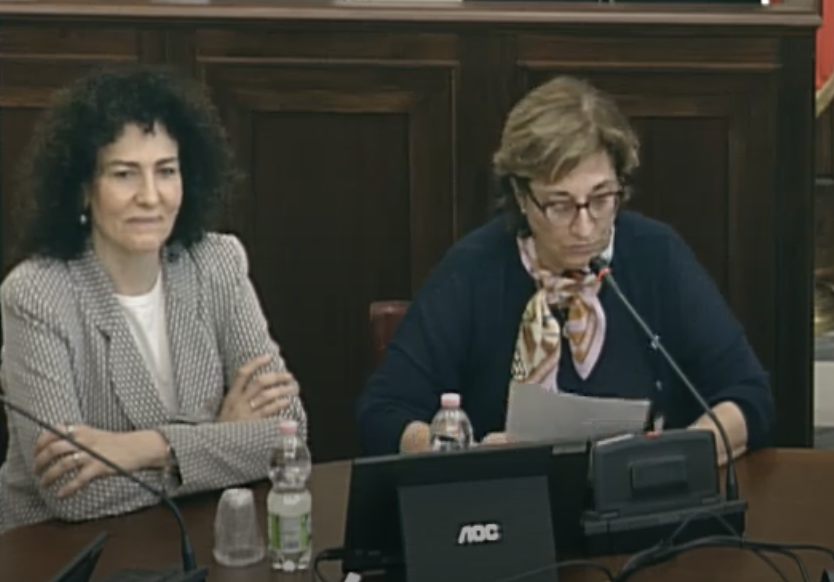
The proposal was the focus of a hearing held on June 24 by the Culture Committee at the Chamber of Deputies. The hearing opened with remarks by UCEI President Livia Ottolenghi. She was joined by the Union’s Vice President, Monique Sasson.
Ottolenghi recalled that the Fascist racial laws had a profound impact on the lives of Italian Jews by “limiting their legal capacity.” Jews were first marginalized, then excluded, and finally persecuted. They were deprived of both their rights and, ultimately, “their lives.” Until now, Ottolenghi said, measures to remedy the confiscation of Jewish property had been “inadequate both in timing and in their results.” According to Ottolenghi, the proposed law “fills this gap by clearly introducing a reparative measure.” In praising the work carried out so far, she also called for expanding the committee which will examine the restitution claims. She hoped for “a broader approach” that would allow the inclusion in the committee of “experts with extensive knowledge of Jewish art,” who might otherwise be excluded because of “overly restrictive formal criteria.”
Contributions to the Debate
Katharina Hüls-Valenti, a professor of Art provenance history at the University of Parma, recognized the “continuing relevance and importance” of the proposed law. According to Hüls-Valenti, the law would enable “systematic research similar to that now regularly conducted in most museums north of the Alps.”
Italy is currently considered to be on the “grey list” regarding the international guidelines established by the 1998 Washington Principles, which were signed by 44 countries, including Italy, as art lawyer and expert Giuseppe Calabi pointed out. He noted that Italy has made “only limited progress” so far in the restitution of looted artwork. In his view, “this highly commendable bill” would provide an important, positive boost.
Historian Michele Sarfatti, former director of the CDEC Foundation in Milan, also spoke during the hearing. From 1998 to 2001, he served on the Anselmi Commission, an Italian government committee that focused on Holocaust-era looted assets. Sarfatti shared his “disappointment” that subsequent governments and parliaments failed to follow the Commission’s lead. He praised the proposed law, suggesting a number of amendments. Sarfatti expressed hope that the Italian state would take action to identify those responsible for wartime looting. According to Sarfatti, the committee should include “an expert on anti-Jewish persecution, an art historian, a specialist in the Hebrew language and Jewish studies, and an archivist.” He stressed the importance of the UCEI’s presence.
The hearing concluded with remarks by Lorenzo Casini, the Rector of the IMT School for Advanced Studies in Lucca. According to Casini, the proposed law raises the fundamental issue of the “relationship between rights, memory, and historical responsibility.” He emphasized that the crimes committed in this context “were an integral part of the discriminatory and predatory policies of Nazism and fascism. ” Casini also noted that, unlike many other countries, Italy still does not have a comprehensive legal framework” governing the restitution of looted artwork. Summing up the meeting, Federico Mollicone said that the hearings “are meant to improve the bill.” He added that the goal is to reach “a single agreed text” in cooperation with the opposition.
a.s.
Translated by Elizabeth El Khoury and revised by Caterina Mansani, students at the Advanced School for Interpreters and Translators of the University of Trieste, trainees in the newsroom of the Union of the Italian Jewish Communities – Pagine Ebraiche.