
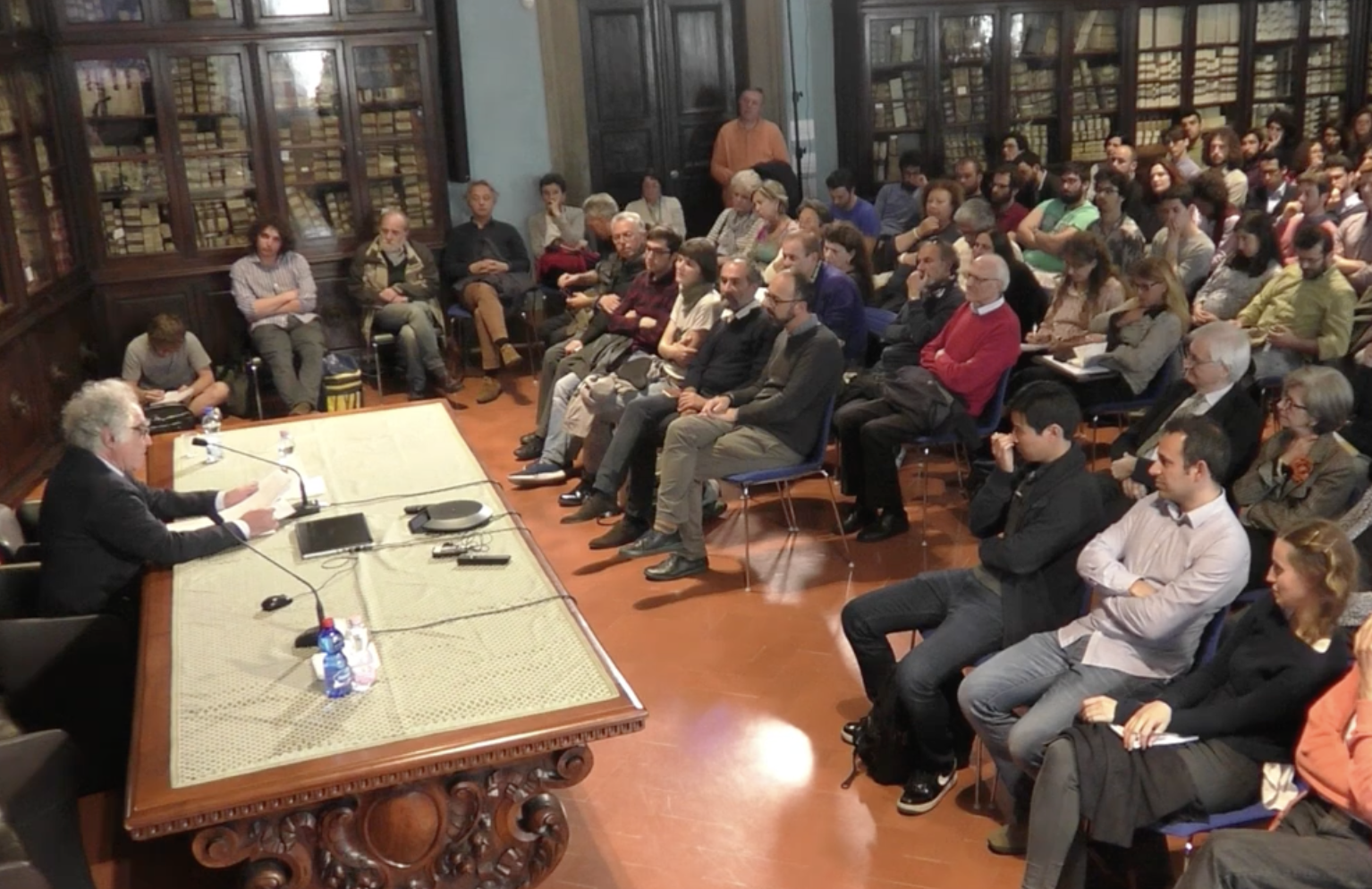
Carlo Ginzburg, an Italian historian whose pioneering work transformed the study of the past by giving voice to marginalized people, died on June 17 at the age of 87. “He was undoubtedly our most important historian and, in some ways, the most atypical. Precisely because of this, his international stature was unparalleled among those I have known, worked with, or even simply read. He was certainly a master for everyone of my generation and those that followed,” historian Marcello Flores told Pagine Ebraiche.
Ginzburg’s book The Cheese and the Worms, published in 1976, was a revelation for Flores. “Although it dealt with a subject completely unrelated to my own interests, which focused on the 20th century, it had an extraordinary power. It had an ability to narrate history, to bring to light the questions we must ask of the past, and to reveal the connections among different disciplines—from anthropology to psychology to economics. All of this made him an absolutely exceptional figure.”
The method that emerged from Ginzburg’s research in Friulian archives gained widespread recognition. “In the 1970s, the major international successes in historical scholarship were mainly in early modern history, which offered opportunities for new methodologies and interdisciplinary approaches that could not easily be followed by contemporary history. His success was twofold: Academically, it was tremendously influential, and it was also a publishing success. The Cheese and the Worms was not only translated and published by academic presses, but it also reached a much broader audience.”
The People Behind Events
Historian David Bidussa reflects on Ginzburg’s intellectual method: “Ginzburg taught me to read sources through different approaches. For him, the issue was not what was true, but what was authentic.” According to Bidussa, Ginzburg’s legacy lies in shifting the focus of Italian historiography from events to people. “In an Italian historiography that, during the 1960s and 1970s, was still largely event-centered—where the goal was to reconstruct the scene, not the individuals, and where there were scenes but no people—he suddenly made people essential.” The focus became the human element within history.” Ginzburg openly acknowledged this debt to Marc Bloch and the philological training he received at the Scuola Normale under Delio Cantimori’s guidance: “There is a profound philological attention, but also an awareness that a text, by itself, says very little unless one investigates how the culture that produced it was formed.” When the Turin-born historian studied heretics, Bidussa added, the question was not merely what ideas they held but also “what books they had read, what kinds of words they had heard, what kinds of practices they engaged in, and therefore what they imagined while carrying out those practices.”
The Jewish Method
In this method, Bidussa also sees an echo of the Jewish interpretive tradition. “Perhaps there is an attention to working within a text and not merely on a text. In the history of the Jewish experience, the surrounding commentary ultimately becomes the text itself.” This connection is not one of identity, but of methodology — the text as a place to be explored, layered, and questioned.
Alberto Cavaglion, a literary critic and historian, agrees on this point, recalling Ginzburg as an “unsystematic” scholar: “He never adhered to any specific historiographical school. Rather, in the spirit of the Talmud or the Midrash, he loved bringing together different interpretations and authors who were often far apart from one another.”
Cavaglion, who met Ginzburg several times with his mentor, Arnaldo Momigliano, highlighted Ginzburg’s rigor and literary style. “I always admired the brilliance of his insights and the beauty of his writing. His books—and indeed all his essays, even the most erudite ones—can be read like stories, like works of great literature, as well as works of outstanding historical scholarship.”
A Lesson for Historians
His books and his method are what remain for those who have read and studied him. “His interests were so numerous and his studies so vast that one always learns an enormous amount from him,” said Cavaglion. For Bidussa, Ginzburg’s lesson lies in his ability to connect sources, language, and lived experience. “There is a great determination to remain close to the texts, but also the clarity of knowing that texts alone are not enough if one does not investigate how culture itself is formed.” For Flores, what remains is, above all, the idea of a master. “From afar, let us say, a master—in the sense that I tried to learn as much as I could from his works.”
Daniel Reichel
Translated by Caterina Mansani and revised by Elizabeth El Khoury, students at the Advanced School for Interpreters and Translators of the University of Trieste, trainees in the newsroom of the Union of the Italian Jewish Communities – Pagine Ebraiche.