
Farewell to Aurelio Ascoli, from Expulsion in 1938 to Professorship in Physics
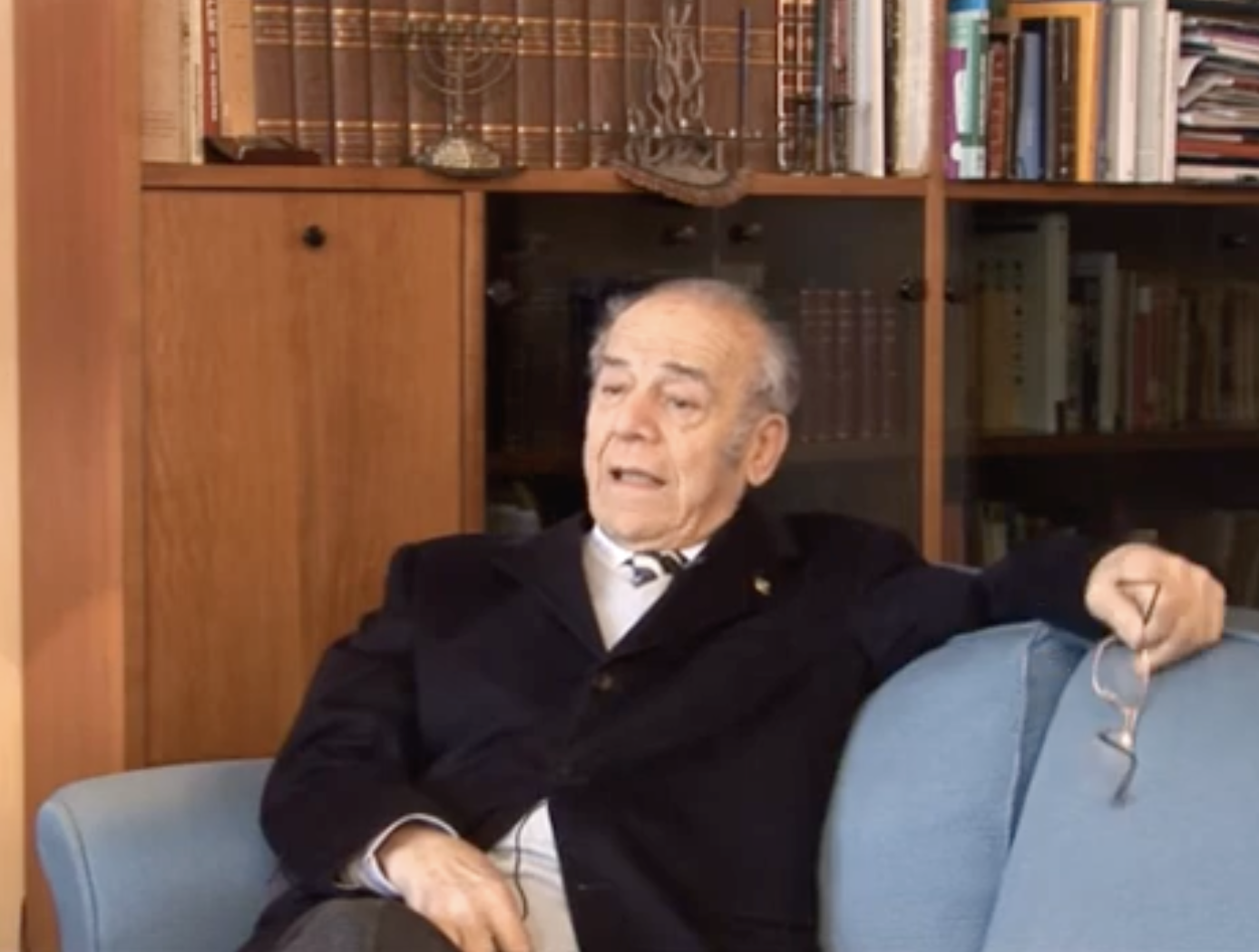
One day in the autumn of 1938, a Fascist official walked into a classroom at the Via Pisacane School in Milan. He wore an orbace uniform, a small black goatee, and leather boots. He stopped in front of the desk closest to the blackboard. A thin boy sat there. Born in Monza in 1929, he was smaller than his classmates because of his build and because he had been promoted a year ahead.
“You, Ascoli, go sit at the last desk,” he ordered. Little Aurelio replied, “Excuse me, why? I have not done anything wrong. And from back there, with the taller boys, I cannot see the blackboard.”
The answer was abrupt: “Go because I told you to. Go home. Your parents will explain everything.”
Aurelio Ascoli, who passed away at the end of November at the aged 93, kept the traumatic memory of that day with him his entire life. “I shed a big tear on my notebook, and the tear smeared ink across the entire page.” He had been expelled from class because he was Jewish. “No one ever called to ask how I was feeling: Nor the teacher, Zambelloni, nor the principal, nor my classmates. It was as if I had vanished into thin air.”
At home, he found his father, Alberto Ascoli, an engineer, Edison executive, and Mazzinian republican. “I saw him literally biting his hands at the thought that Italy had sunk so low,” Aurelio later recounted during public testimonies in Milanese schools. “That, for me, was a comfort. I saw that he still reasoned with his own mind.”
This became a lifelong lesson for Ascoli. “Aurelio was a scientist. He was a traditional physics professor: very strict, but highly respected. He had vast knowledge and a very advanced critical spirit.” He read all my texts and analyzed them with extraordinary clarity,” Liliana Picciotto, a historian at the CDEC Foundation, recalled in an interview with Pagine Ebraiche.
“He helped me immensely in my work,” Picciotto continued. “He came with me to the municipal and American state archives to look for information on deportees. He was one of those great old scholars who knew everything. He spoke perfect English and French, understood German, and if we needed a difficult translation, he would study and do it himself. His culture was deep and layered, yet never flaunted. “He remembered Catullus and poems from high school by heart. He recited them very well, almost theatrically.”
After the 1938 expulsion, the City of Milan set up a temporary school on Via Spiga. Jewish children could only attend classes in the afternoon, separated from their non-Jewish peers. “I was in fifth grade. I stayed there less than a week. Then I never went back,” Aurelio Ascoli recounted.
As the antisemitic persecution grew harsher, his family left Milan to seek safety. After September 8, 1943, they prepared to escape to Switzerland. “We were lucky,” Ascoli emphasized. He, his parents, and his sister were allowed to cross into Switzerland while others were not. “One day yes, and two days no. My friend Arno Baehr was turned back three times. Professor Pio Foà was turned back just as the Nazis were about to reach him. And they did reach him.” Foà was murdered in Auschwitz in December 1943.
The Ascoli family found refuge across the border in Switzerland and stayed there until the end of the war.
Aurelio returned to Italy on September 21, 1945. He resumed his studies, earned his classical high school diploma, and enrolled in engineering school. From there, his scientific path began. He specialized in nuclear physics, and later, in solid state physics. He worked at the Center for Information, Studies, and Experiments (CISE) in Milan and became a physics professor at the state university. “He belonged to that group of great old scholars who knew everything. His mind was crystal clear right until the end,” Piciotto concluded.
Eighty-five years after his expulsion, Ascoli accepted the school on Via Pisacane’s invitation. He returned to the classroom from which he had been expelled in 1938. White flowers and a sign reading “Welcome back, Aurelio” greeted him. He asked the children only one thing: “Always think with your own mind. Always. Monstrosities happen when people stop doing that.”
Daniel Reichel
Translated by Alessia Tivan and revised by Matilde Bortolussi, students at the Advanced School for Interpreters and Translators of the University of Trieste, trainees in the newsroom of the Union of the Italian Jewish Communities – Pagine Ebraiche.