
Liliana Segre: “A Time We Should Not Be Living”
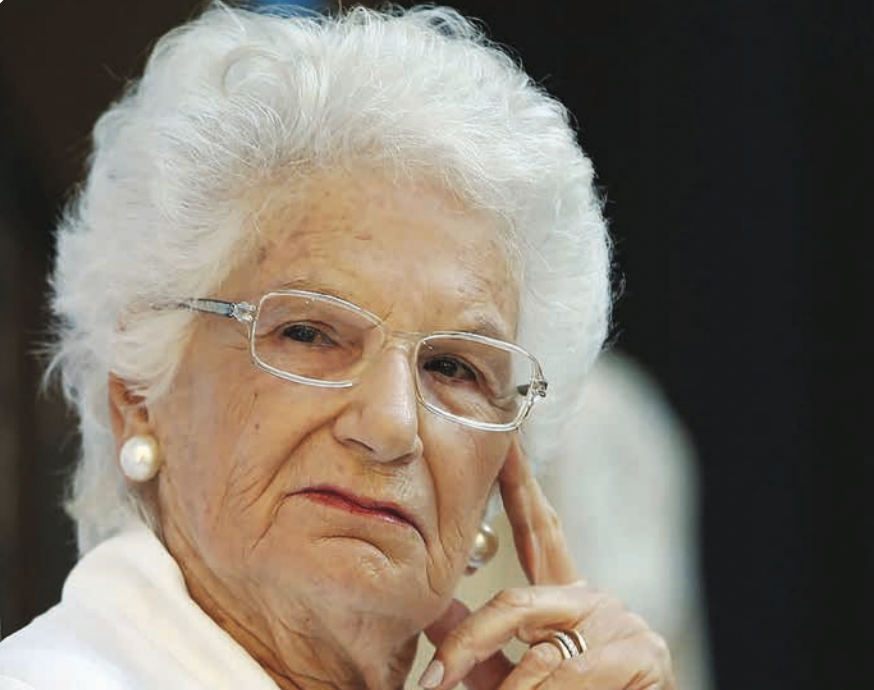
“Luckily, Nedo Fiano was spared this spectacle. He did not see this terrifying new wave of antisemitism,” said with disappointment Senator for Life and Holocaust survivor Liliana Segre. At 95 years old, she is one of the last Italian witnesses of the Shoah. “Frankly, I no longer wish to live in these times,” she confides to Pagine Ebraiche, referring to a time when hatred, antisemitism, and historical distortions have become everyday occurrences.
The occasion for speaking is a remembrance of Nedo Fiano, a Holocaust survivor who died in 2020, to whom director Ruggero Gabbai dedicated his latest documentary film. “Nedo was a person of extraordinary generosity,” Segre recalled. “He spoke about his experience for years without ever holding back. We had different ways of bearing witness, and I started much later than he did, but we were united by a special bond.”
Their friendship grew over time. It was made of mutual respect and a commitment to bearing witness. “He had a direct, sometimes theatrical way of speaking to young people. I chose a different register,” Segre said. “But Nedo was always capable of leaving a mark. Today, very few of us remain, and the present is a sorry sight.”
The senator’s tone is disillusioned but never defeated. Even when she speaks of long-standing friendships that have faded, she did so with irony. “I play bridge. I enjoy it. But now, I am invited much less. People I had known for thirty years suddenly have no time. Elderly ladies like me, I say. Not young girls.” Some acquaintances have approached her to say, “You Jews are smarter; you made money at the right time.” “But who do you mean by ‘you’?” Segre asked, speaking of a prejudice that is now widely accepted and ranges from ignorant remarks to violent threats.
This climate, she observed, does not arise out of nowhere. Rather, it results from a cultural impoverishment that renders once-unspeakable words acceptable. “Speaking casually about genocide is not helpful. I saw what genocide is. It was not this. Politicians use it as a tool for consensus,” she stresses. She rejected any comparison between the Holocaust and Gaza. What worries her most is the loss of historical knowledge. “History and geography are no longer studied. Young people know everything about singers and footballers, but they do not know what existed in Palestine before the protectorate, for example.”
Senator Senator Segre reiterated her pessimism about awareness of the Nazi-Fascist persecutions. “First, the Holocaust will become a single line in history books. Then, it will not even be mentioned.” And yet, she continues to speak out. “It’s becoming less and less, because at my age this is hard. But I spoke with the Quirinale, and for Holocaust Remembrance Day, I will go to Rome. It will be a great sacrifice, but I want to be there.”
She will have to do so under police escort. “I am 95 years old, and I have not been able to leave the house alone for seven years. I cannot even cross the threshold without an escort. They are my guardian angels, but it’s unbelievable that I need them.” This protection is necessary because of the constant threats. “The kindest things I am called are ‘piece of shit,’ ‘whore,’ ‘Nazi.’ ‘Nazi’ is always there.” It is a paradox for someone who survived Auschwitz, where she lost her father and grandparents. It is especially so for someone who did not take revenge on a Nazi when she had the chance. “I did not pick up the gun that fell from my tormentor. At that moment, I chose life. From then on, I have been a free woman and a woman of peace.”
Segre has responded to the most serious of the insults in the lawsuit. “The Italian president, Sergio Mattarella, asked me to do so. I would not have done it; it is not in my nature. But the threats are in the thousands, not just from five or ten people. There are tens of thousands.” For this reason, her lawyers file dozens of complaints every year. “I am not doing this for compensation. I do not want a single euro. I always donate everything. I do it to say that this language cannot be ignored.” Speaking about the reemergence of antisemitism in Italy, she added, “The new scenarios are so ugly that being afraid again is too much. That is enough. Enough of all this rhetoric, of all these meaningless words.”
Daniel Reichel
Translated by Matilde Bortolussi and revised by Alessia Tivan, students at the Advanced School for Interpreters and Translators of the University of Trieste, trainees in the newsroom of the Union of the Italian Jewish Communities – Pagine Ebraiche.