
Giorgio Bassani, 110 Years from His Birth: Women Between Reality and Novel
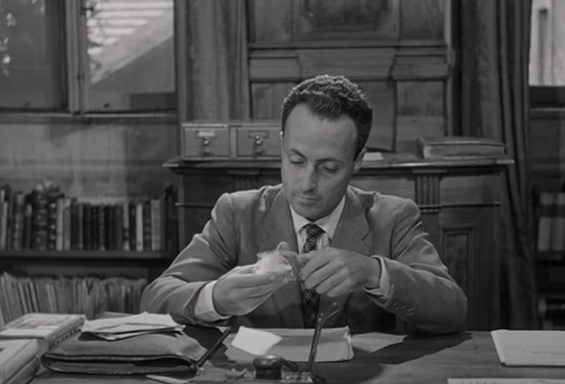
March 4 marked the 110th anniversary of the birth of writer Giorgio Bassani. Throughout his life, women were typically portrayed as strong and influential figures who played central roles in 20th-century cultural life. However, in his books, they are almost always portrayed as vulnerable figures affected by history and society. The difference between real and imaginary women was the main theme of the March 8 event, “From Micòl Finzi-Contini to Anna Banti: The Double Face of the Feminine in Bassani,” which took place at the MEIS (National Museum of Italian Judaism and the Shoah) in Ferrara.
Rosy Cupo, a Sorbonne Nouvelle University researcher, explained this duplicity to Pagine Ebraiche. Cupo is the author of the book Con una certa impazienza (With a Certain Impatience), which is dedicated to the correspondence between Anna Banti and Giorgio Bassani from 1948 to 1966. The book was published by Giorgio Pozzi Editore. Cupo’s work on Bassani’s archive, dedicated to the writer’s international relations, inspired the MEIS initiative.
She explains: “I carried out a project on Bassani’s relationships with intellectuals, publishers, and translators around the world.” The goal was to observe how his thought shifts when he interacts with these individuals, who offer a broader perspective than the Italian one.” The research program also included a component aimed at disseminating the findings to the general public. That’s why the idea of involving the Ferrara Museum was born.
Bassani and women
“One of the publications resulting from these two years of work is the correspondence between Bassani and Anna Banti,” Cupo explained. The volume contains nearly 20 years of letters between the writer and the prominent Italian intellectual, whom Cupo described as “one of the most sophisticated figures of the 20th century.” The coincidence with International Women’s Day on March 8 therefore suggested focusing on their exchanges. Cupo highlighted that the relationship between Bassani and Banti was “so complicated.” Banti was about ten years older and had a strong, independent personality. “Theirs was not a real friendship. They didn’t love each other in a sentimental way. But there was a very strong mutual respect.”
The event also honored Marguerite Caetani, the founder of the magazine Botteghe Oscure. It was precisely thanks to that experience that Bassani entered the postwar literary scene and the publishing world of narrative fiction.
Yet, the conference principally focused on comparing real women to those described in the novels. “In his works, Bassani describes women as victims of history, society, and often, men,” Cupo explained. But there is an exception. “The only character whom Bassani explicitly says has “a much purer soul” is Clelia Trotti, the literary transposition of Alda Costa,” Cupo observed.
This is a very rare statement in Bassani’s works: “It is an expression that Dante might have used for Beatrice in his poem Paradiso.” For the scholar, this suggests a possible interpretation of Bassani’s view of femininity. “Perhaps, without fully realizing it, he believed women were capable of achieving perfection.”
Yet, the distance between reality and literature remains evident. In his personal life, Bassani socialized with influential women who were able to establish themselves in the cultural world. In his books, however, women are often characterized by marginality or defeat. The most notable example is Lida Mantovani from The Novel of Ferrara. She has been abandoned and is doomed to live in resignation and solitude.
A more complex figure is Micòl Finzi-Contini, the protagonist of The Garden of the Finzi-Continis. “Micòl is perhaps the only one who partially escapes this pattern,” Cupo observed.
Bassani described her as the only character animated by an authentic desire for life, even though she is immersed in a world — that of the garden — destined to disappear. The talk at MEIS also addressed the relationship between the literary Micòl and the real-life figures who may have inspired her. Scholar Marcello Azzi of Fondazione Bassani focused on this aspect.
d.r.
Translated by Elizabeth El Khoury and revised by Caterina Mansani, students at the Advanced School for Interpreters and Translators of the University of Trieste, trainees in the newsroom of the Union of the Italian Jewish Communities – Pagine Ebraiche.