
Livia Ottolenghi (UCEI): Dialogue and Unity the Goals of My Term
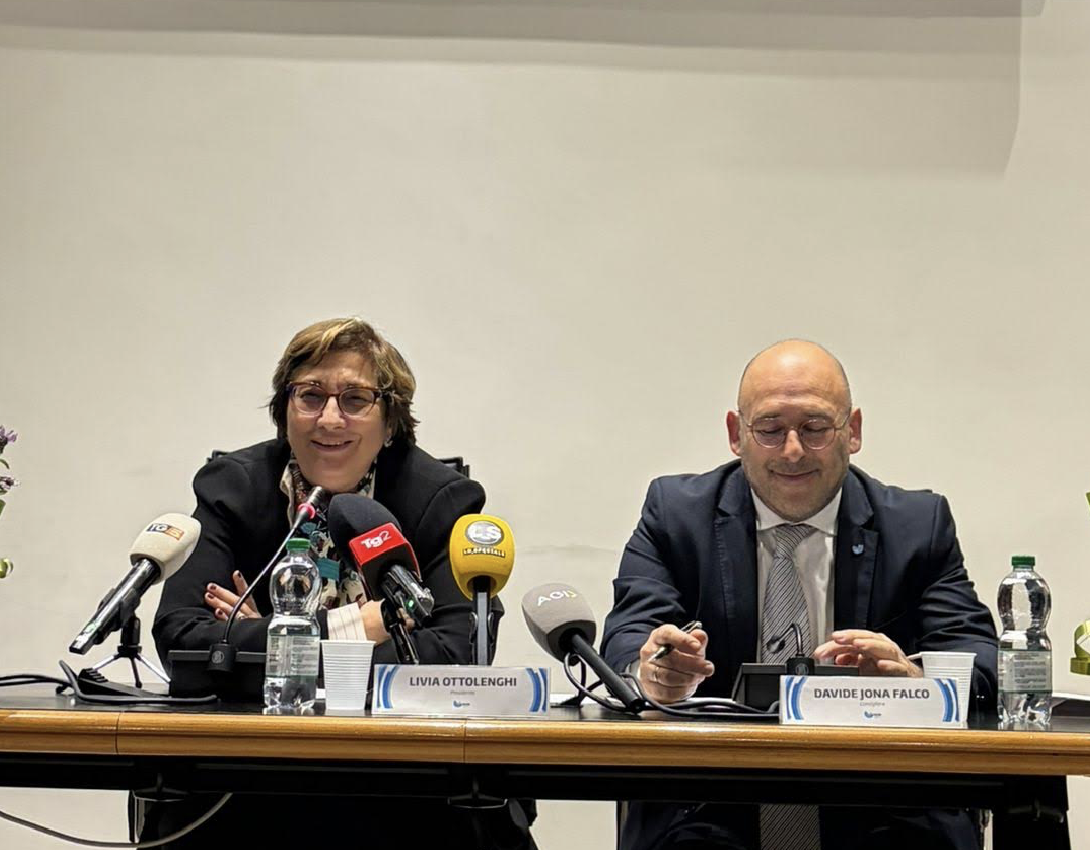
Three weeks after her election, Livia Ottolenghi, president of UCEI, the Union of Italian Jewish Communities, presented the strategic priorities of her term. On March 3, at a press conference held at the Italian National Library of Judaism “Tullia Zevi” in Rome, she outlined her short- and long-term goals, the actions she intends to take, and her plans for collaboration in Italy and Europe.
Also present was Davide Jona Falco, who was confirmed as the UCEI councilor of Communication. Former UCEI president Noemi Di Segni attended the conference. Ottolenghi, who served as Education councilor on the previous board, took over from Di Segni in mid-February.
The first question focused on the ongoing conflict in the Middle East. “The situation is worrying, with potentially unpredictable developments that everyone fears,” said Ottolenghi. The newly elected president reminded the press of the UCEI’s patronage of the recent “With Iranians for a Free Iran” demonstration, which was organized in solidarity with the Iranian people, who are oppressed by a regime that disregards human rights and is a destabilizing force through its proxies. This destabilization affects many people in the area, particularly Israeli citizens who have been targeted by missiles for over two years.
Regarding the recently approved law against antisemitism by the Italian Senate, Ottolenghi noted, “It is a good result, although we would have welcomed greater support and consensus on it. It was painful to see votes against it and abstentions.” Referring to the alarming results of the new annual report on antisemitism by CDEC, Ottolenghi emphasized that the law “addresses a real, current need. The situation of antisemitism is alarming in both Italy and Europe.” “It is not easy to be a Jew in Italy,” Ottolenghi said, highlighting that Jewish life in Italy is “a life under escort” from the beginning of school and requires significant limitations and attention. “Italian Jews live well thanks to the institutions and police enforcement that protect us. This law provides an important response to that as well.”
Councilor Jona Falco explained that the definition of antisemitism by the International Holocaust Remembrance Alliance (IHRA) and the context of the law “are topics of discussion. However, what matters most is the collective assumption of responsibility. Even though there has not yet been unanimity, we are satisfied that Parliament reached a consensus.”
Rebuilding dialogue
Regarding education and shrinking spaces for free debate, Ottolenghi argued, “We need to organize educational and informational activities that foster a better understanding of Judaism and Jewish realities. Most importantly, these activities must allow everyone to express their point of view in a dialogue, even if it is heated.” In some cases, especially at universities, “a culture of free exchange of ideas must be rebuilt, but I am very confident.” Ottolenghi referred to a webinar aimed at teachers about Judaism, promoted by the UCEI and attended by over 460 teachers from across the country. “These are heartfelt topics. There is interest,” she said. Councilor Jona Falco confirmed: “We receive a lot of support, even if it makes less noise.”
The challenge of unity
Ottolenghi began by presenting three objectives that she intends to pursue as head of her unitary executive board. The first is “sharing, which involves real delegation and careful listening to the needs of the communities.” The second objective is “enhancing the Jewish communities to strengthen Jewish life and increase its presence.” The third objective is “systematically promoting the cultural aspect.” One of the events mentioned is the 40th anniversary in December of the Nobel Prize in Physiology or Medicine awarded to Rita Levi-Montalcini.
“The unitary nature of the new council and presidency is particularly significant given the times we are living in,” said Jona Falco. “Ottolenghi presides over a coalition board in a spirit of collaboration and compromise between the various positions. We are at the beginning of a journey, but we are satisfied with this unity.” Ottolenghi emphasized that this unity “gives meaning to the response of Italian Judaism to the serious moment we are experiencing.” When announcing the press conference, Ottolenghi said: “My commitment will focus on consolidating the UCEI’s role as a point of reference for Italian Jewish communities and as an authoritative interlocutor on the national and international scenes. It is essential to work together to ensure continuity, cohesion, and a future for Italian Judaism.”
a.s.