
Amid Missiles and Shelters, Italians in Israel Deserted Vote on Italian Constitutional Referendum
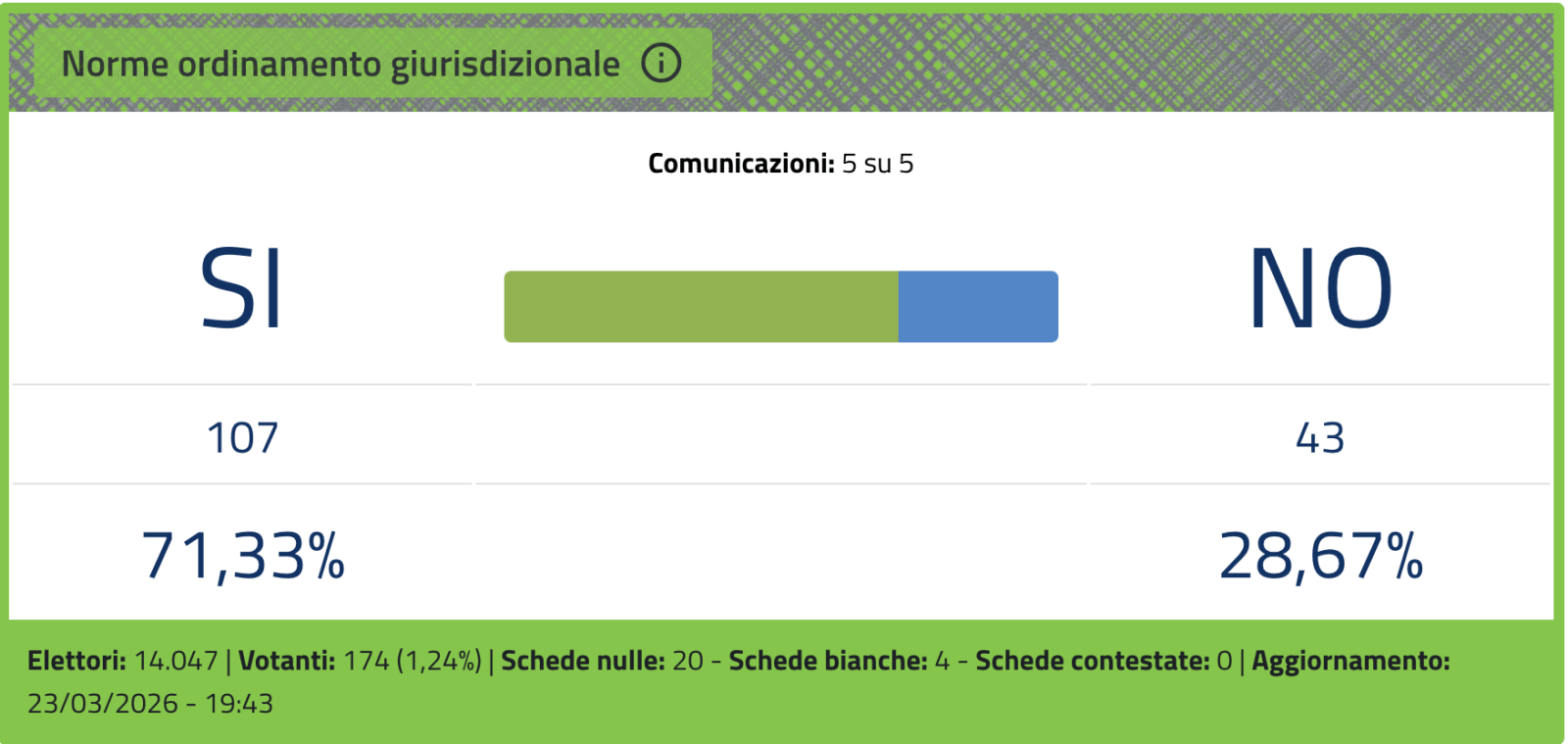
With the threat of Iranian missiles looming over them daily, the March 22 and 23 referendum to overhaul Italy’s judiciary was not a priority for Italians in Israel. Only 1.24% of eligible voters exercised their right, casting about 150 ballots out of a total of over 14,000.
“It was truly a mass desertion,”retired Italian-Israeli demographer and statistician Sergio Della Pergola pointed out to Pagine Ebraiche. He noted that, under different circumstances, turnout had previously been around 20-30%. “The vote from abroad has always been relatively scarce, but in this case, it was an absolute mass desertion. There is a sense that the matter is irrelevant for those who live here, especially when missiles are raining down.”
This results from a combination of factors. First, the practical difficulties of mail-in voting affect participation. Della Pergola, an influential voice of Italians in Israel, confirmed this, recalling an emblematic personal episode. “In itself, the procedure works,” he said. The ballots are delivered. However, once the vote is cast, “it is mandatory to go to the post office or deliver the envelope directly to the embassy or consulate general offices,” which is not always simple in the midst of a war.
“I put my ballot in the envelope and went looking for a mailbox to send it,” he explained. “I found out that the mailbox no longer existed. The post office was closed, so I went back home. Unfortunately, my vote never left.” He hypothesized that the mailbox had been removed as a precaution “to prevent a missile fragment from hitting or damaging it.”
Another challenge was understanding the actual content of the question. “The text of the referendum is almost illegible, especially for those following the debate from abroad,” explained Della Pergola. The reform would have split Italy’s judiciary into separate career paths for judges and prosecutors, divided the Superior Council of the Magistracy into two bodies, and established a new Disciplinary Court. Ultimately, Italian voters rejected the constitutional reform, with around 55% voting no and 46% voting yes, based on nearly all the votes counted. Turnout reached nearly 59%.
However, the context was what truly mattered to Italian-Israeli voters. In a life marked by sirens and shelters, “even the most obvious activities should follow a well-structured procedure.” Theoretically, the best time to run errands is right after a missile falls, because you know you have a time window before the next one. Everybody acts like this.” In these conditions, voting in the referendum has not been a priority.
Moreover, there is a widespread perception of Italy’s distance from the conflict. “Maybe we expected a firmer and clearer position against Iranian missiles targeting Israeli homes. There have been attacks on Tel Aviv in densely populated neighborhoods. The Iranians are using cluster bombs, which are technically banned under international conventions,” Della Pergola emphasized. As a result, the demographer continued, those with Italian passports may have thought, “If they don’t care about us, why should I pay attention to this referendum?”
Among the few who voted, the “Yes” side prevailed over the “No” side with 71.33% of the vote, receiving 107 and 43 votes, respectively. However, the numbers are too small to draw any statistical conclusions, according to Della Pergola. This is partly because some of the voters are likely related to Italian institutions in the country, such as embassy officials and stationed staff.
These data should be interpreted considering an administrative peculiarity: The votes of Italians in the area are divided into two separate constituencies. The “Israel” constituency includes the above numbers. The autonomous constituency, which covers Jerusalem and the Palestinian territories, had higher voter participation: 302 out of 2,578 eligible voters, or 11.71%. In this constituency, the “yes” side prevailed with 155 votes (53.08%), compared to 137 votes (46.92%) for the “no” side.
d.r.
Translated by Caterina Mansani and revised by Elizabeth El Khoury, students at the Advanced School for
Interpreters and Translators of the University of Trieste, trainees in the newsroom of the Union of the
Italian Jewish Communities – Pagine Ebraiche.