
Students Embrace Former Israeli Hostage Eli Sharabi: “I Don’t Want to Live in Anger”
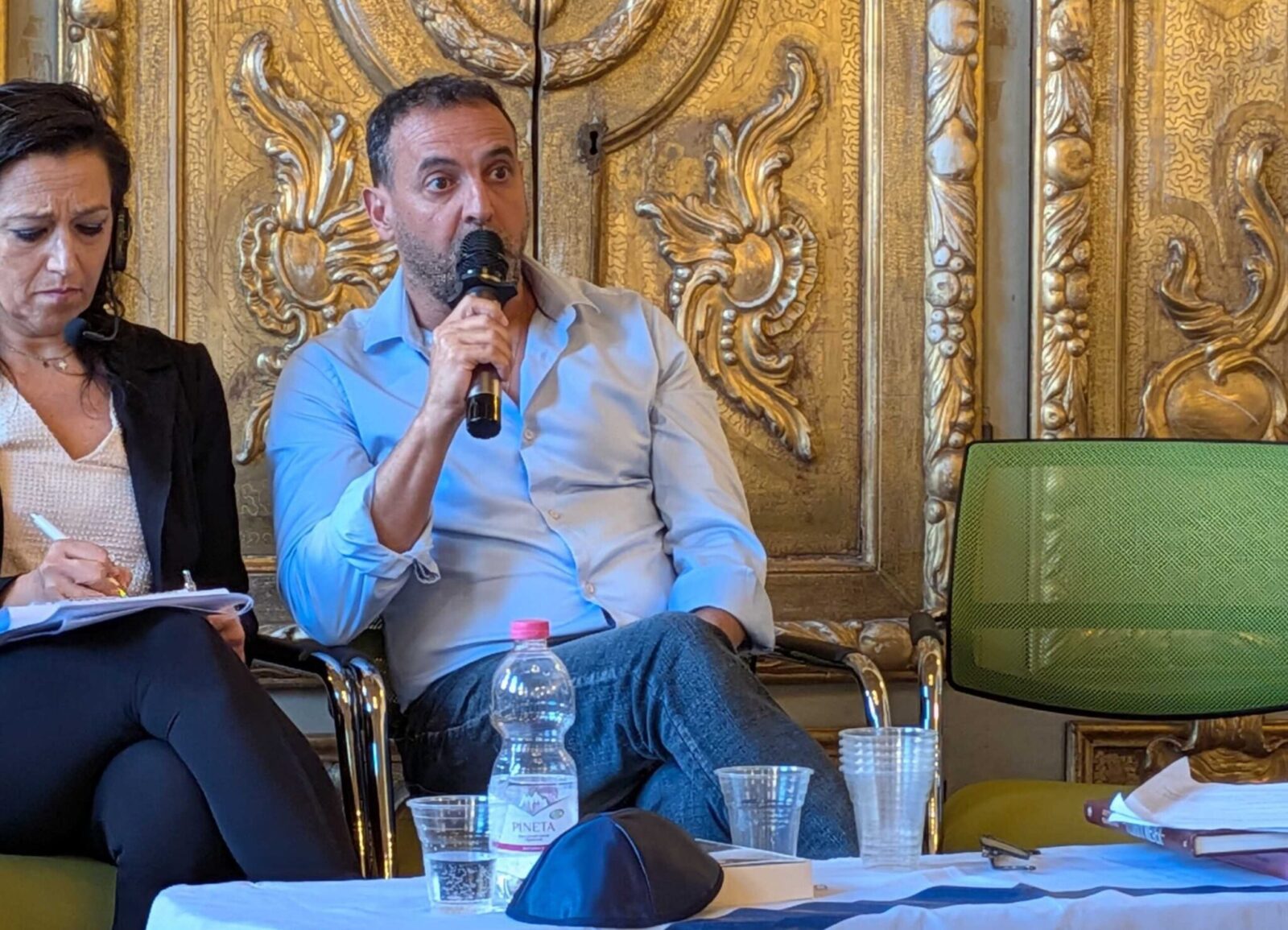
The applause for Eli Sharabi never seemed to stop. Young people who gathered at the Jewish Community of Ferrara listened silently to the story of his 491-day captivity in Gaza. They heard how Hamas terrorists had ripped away the people he loved: his wife, Lianne, and his daughters, Noya and Yahel. They were murdered in their home on October 7 while he was dragged away. And yet, despite everything, he chose not to stop. “I am here,” he said. “I keep speaking. I keep telling people what happened. This is the only thing I can still do for them.”
Eli Sharabi won the main section of the Adei-WIZO Adelina Della Pergola Literary Prize for his autobiography, The Hostage, published in Italy by Newton Compton. He lived for 35 years in Kibbutz Be’eri, which is just five kilometers from the Gaza border. “For us, it was paradise,” he said. That was where he met his wife, Lianne. She had arrived from England for a three-month stay but ended up staying. There, he watched Noya and Yahel grow up. “We had a magical life. A family. A community. We had a place in the world.”
On the morning of October 7, they woke up at 6:30 a.m. to the sound of sirens. Like so many times before, they took the girls to the shelter. Four hours later, the terrorists broke down the door. “We threw ourselves over the girls to protect them. We gave them our phones. We did not resist because we believed it was the best way to keep them safe,” he recalled. Two men dragged him out. “I shouted to my daughters that I would come back. It was the last time he saw them.”
Lianne, Noya, and Yahel were murdered just minutes later. For 52 days, he was held inside the home of a Palestinian family. Then came the tunnels, fifty meters underground, where he spent another 440 days with other hostages who had been kidnapped from the Nova Music Festival. “They chained us by the legs, sometimes to each other. The worst thing was the hunger. During the last seven months, we got only one meal a day—a few pieces of pita,” he recounted. From October 7, 2023, to his release on February 8, 2025, Eli Sharabi lost nearly thirty kilos. “But what really consumes you is not the body,” he said. “It’s the not knowing what’s going on outside. It is the silence.”
After his testimony, students’ questions flooded in, filled with emotion and gratitude. When one asked Sharabi where he found the strength to keep going, he recounted the day of his release when he was still convinced that he would meet his family again. When he realized that it was no longer possible, he cried for a while. All I wanted was to be with my loved ones.” Just ten days after leaving the hospital, he had already begun traveling around the world to share his story. “I know that for almost 500 days, my family and friends fought for me. I don’t feel I have the right to stay in bed crying all day,” he said. Writing the book, he added, was therapeutic. “That is why I do not suffer from post-traumatic stress disorder.”
A student asked how he deals with the hostile atmosphere toward Israel and the Jewish world. “People were waiting for an excuse to release that hatred. Many of those shouting slogans don’t even know where Palestine is.” Speaking about anger, he reflected: “If I saw my captors walking down the street tomorrow, I would probably eliminate them. But anger is not what drives me in everyday life.” Then he added, “I am a very practical person. I find no strength in sadness or anger. When I learned that Lianne, Noya, and Yahel had not survived, it was—and still is—incredibly painful. But I try to carry that pain with me, not instead of living, because I love life.”
Daniel Reichel
Translated by Elizabeth El Khoury and revised by Caterina Mansani, students at the Advanced School for Interpreters and Translators of the University of Trieste, trainees in the newsroom of the Union of the Italian Jewish Communities – Pagine Ebraiche.