
Multicolour Tales of an African-Italian Jewish Filmaker
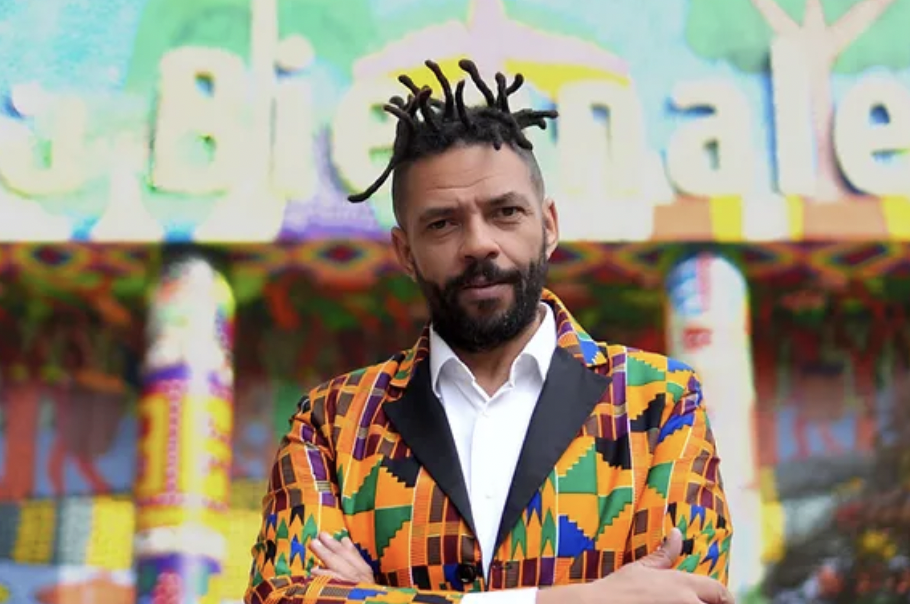
The Jewish-Ethiopian community of Beta Israel has long requested greater representation in Israel’s public discourse. Perhaps for this reason, a Ben Gurion University student in Beersheba asked Italian filmmaker Fred Kudjo Kuwornu to share his story.
Kuwornu is of Jewish and African origin, and making the invisible visible is at the core of his work. His awareness stems from his personal experience. “At school in Bologna, I was the only student with a Jewish mother and a Ghanaian father. No other kid was like me — not Jewish nor African. I tried for a long time to resemble the others,” Kuwornu explained to Pagine Ebraiche. Over the years, his desire to blend in evolved into a critical eye and a narrative need.
“Representation is not always related to reality, but depends on who is in control of the media. In Italy, for a long time, minorities simply did not exist in the public narrative. Kuwornu has tried to fill the void with documentaries such as Blaxploitalian, which reconstructs a century of Black presence in Italian cinema, and We Were Here, which sheds light on African figures in Renaissance paintings. The film was presented at the Venice Art Biennale.
His journey in cinema began almost by accident. A recent Political Science graduate with some experience in radio and TV, Kuwornu landed a job on the set of Spike Lee’s Miracle at St. Anna as an extra and assistant. The film is dedicated to the African-American soldiers who participated in the Italian campaign during WWII. “When filming wrapped up, I felt the need to research the topic more in depth,” he said. This research culminated in his first documentary, Inside Buffalo, which is about those forgotten soldiers.
From there, he began a consistent path of giving voice to the voiceless. A recent visit to Israel fit perfectly into this trajectory. Several academic institutions, including Ben-Gurion University and Professor Cristina Bettin, invited Kuwornu to speak about the evolution of the representation of Black people in Italian cinema and the relationship between identity, memory, and the Afro-Italian experience. “The students were amazed,” he says. “They did not expect to see so many portraits of African individuals during the Renaissance. They exist, but are often ignored or misinterpreted. The titles of paintings, assigned centuries later, often refer to an ‘African man’ standing next to the ‘duke.’ People tend to assume he was a slave or servant. But maybe he was a diplomat or an ambassador.”
Kuwornu said another distortion is the myth of homogeneity. “History is the result of contamination. Even what we call Italian culture, Italian food, and Italian art emerged from encounters and influences. The ‘Made in Italy’ brand works because it’s the product of a long history of blending. We continue to consider it ‘pure,’ but it never has been.”
In Israel, the filmmaker received the Dan David Prize, which is awarded to those who explore humanity’s past. “This prize invests in research and its meaning for the future. It has been an honor.” Between research and the future, Kuwornu’s Jewish roots resurface. “My mother is part of the Jewish community of Ferrara,” he said. “For years, I have been thinking of making a documentary about that community, which is shrinking more and more. I would like to tell this story through people’s daily lives, especially that of Rabbi Luciano Caro. At 90 years old, he still travels across Italy by train to keep a small but tenacious community alive.”
For Kuwornu, representation impacts the right to imagination as well. “When people are always portrayed as poor, immigrants, or victims, they conclude that it is their destiny. Stereotypes are not the only problem, though. There is also an absence because some stories simply don’t exist. Italian Jews, for instance, are not represented. Maybe there is a Jewish character, but we never see them living their culture or celebrating their holidays. They are always the ‘other,’ even though they’ve been Italian for millennia.” Minorities themselves often fall into the same trap. “We are so accustomed to certain patterns that we unknowingly replicate them. That is why we need deep work, even at the institutional level. As long as they do not do it, we must do it ourselves and tell our stories. Even if the audience is small and it is hard. It is still a way of asserting our existence.”
Daniel Reichel
Translated by Rebecca Luna Escobar, student at the Advanced School for Interpreters and Translators of the University of Trieste, trainee in the newsroom of the Union of the Italian Jewish Communities – Pagine Ebraiche.