
History of Central European Judaism
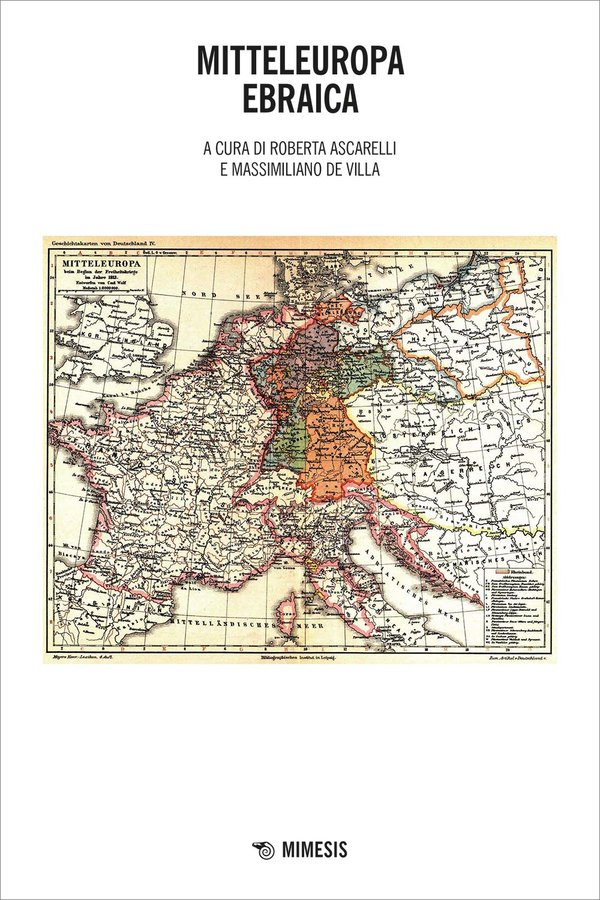 Autobiographical testimonies, literary texts, and articles published on newspapers and periodicals. These are the sources used by the authors of the series of essays contained in Mitteleuropea ebraica (Jewish Central Europe), a 590-page book edited by Mimesi Edizioni. This fascinating volume takes readers on a journey through the land “in the middle” that has been shaped by the Jewish experience in many, perhaps contradictory, ways. The curators of the work, Roberta Ascarelli and Massimiliano De Villa, state that it is still worth talking about this legacy and confronting it, premising that “the history of Judaism in Central Europe raises issues of wide scope, like land borders, immigration and relocations, thus offering a possibility of critical projection onto more recent events.”
Ascarelli and De Villa are both university professors. Ascarelli has written essays on Joseph Roth and Stefan Zweig, and De Villa has written essays on Martin Buber, Paul Celan, and Franz Rosenzweig, among others. Through Mitteleuropea ebraica, the curators allow us to wander from Vienna to Prague, Lviv to Trieste, Krakow to Czernowitz, and Budapest to Ljubljana. They recount stories of these cities’ grand intellectual salons and the tumult of the Haskalah (“Jewish Illuminism”) and the contrasting Hasidic movement with its pietistic tendencies.
Central Europe is a land that has always been caught between cosmopolitanism and small homelands. It is also a land that has been partly Yiddish. “A submerged family secret language,” writes Simona Leonardi in her contributions to the topic of mameloschen (mother tongue in Yiddish) and immigration from Eastern Europe to Germany.
On the same topic, Guido Massimo discusses Yiddish theater actors “from Galicia to Budapest in the footsteps of Kafka.” Esther Saletta introduces us to Mitteleuropa in Vienna. Thanks to the poet Veza Canetti, wife of future Nobel Prize winner Elias, it is a land with “deep Sephardic roots.” Highlights of the book include Joseph Roth’s chronicles from Central Europe. In his 1927 essay, “Wandering Jews,” he captured the final moments of a world on the brink of collapse, as well as the big-screen adaptation of the Golem myth.
It is certainly a complex reflection on the past and a “world of yesterday” whose reservoir of stimuli has not yet been exhausted. According to Ascarelli and De Villa, “If we consider it as a modern myth with elusive political characteristics but with great cultural charm, Central Europe today still has the capacity to make people wonder about the relationship between the city center and the outskirts, imposing a radical reconsideration of the concepts of transculturality and transnationality.”
According to the curators, this reconsideration “hits the contradictions of contemporary Europe, questioning apparently monolithic forms of identity connected to territorial, linguistic, ethnic, and religious borders.”
Translated by Rebecca Luna Escobar and revised by Matilde Bortolussi, students at the Advanced School for Interpreters and Translators of the University of Trieste, trainees in the newsroom of the Union of the Italian Jewish Communities — Pagine Ebraiche.