
Gilberto Salmoni Passed Away at the Age of 97. He Was the Last Italian Survivor of Buchenwald
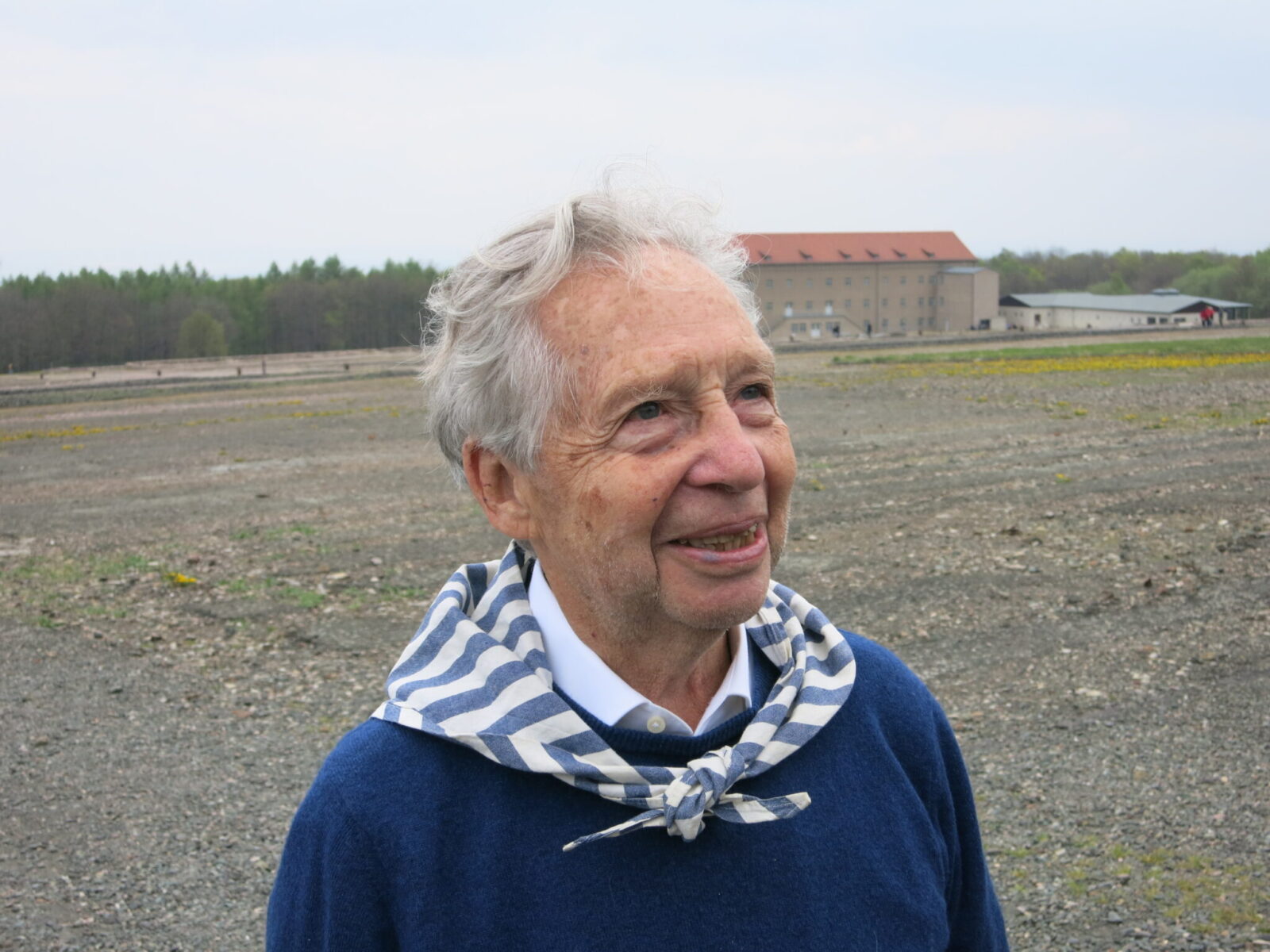
“Buchenwald was a place of pain for everyone. For many, it was pain and death. For many others, it became a seed for profound and exceptional reflection.” It took Gilberto Salmoni almost half a century to find the words. For years, he tried to bury that horror in his everyday life: Work, family, and the future. He recounts this in his autobiography, Una storia nella storia (A Story Within History), published by Frilli Editions. The Holocaust was not forgotten, but set aside to survive. Then, in the 1990s, that memory resurfaced, and Salmoni began to speak. He saw himself as a “resistor in the camp” and “a disarmed fighter” who was still standing to deliver to new generations an idea of Italy and Europe different from those that had swallowed his family at Auschwitz. “I want to send a message,” he said in 2019 while speaking before the Italian Parliament. “A united Europe is a great achievement. It is a true beauty. Let us not ruin it.”
Salmoni died on February 1 at the age of 97. With his passing, the last Italian survivor of Buchenwald is now gone. He was also the last Holocaust survivor from Genoa. Born on June 15, 1928, he was the youngest of three children. He grew up in a Jewish family that was well-integrated into city life. In 1938, the fascist racial laws brought a sharp break for them. Gilberto was expelled from public school. His father lost his job, and friendships faded away.
In 1944, when Gilberto was 16, the family attempted to flee to Switzerland. Like many Jews, they were turned back and arrested by the fascist authorities of the Italian Social Republic at the border. They were probably betrayed by a smuggler. Thus began the deportation. First came the prisons of Bormio, Tirano, Como, and Milan’s San Vittore. Then, there was the Fossoli transit camp in the Emilia-Romagna region. In August, he was separated from his parents and his sister, Dora, who had been seriously wounded during an Allied bombing of Fossoli. The three were deported to Auschwitz, where they were murdered upon arrival.
Gilberto and his older brother Renato, a doctor, were instead deported to the Buchenwald concentration camp in Germany. Salomoni wrote that life in the lager was made of “continuous changes, sudden disappearances, and a humanity falling apart without noise.” To survive, one had to narrow one’s focus and harden oneself. However, alongside violence and constant fear, Salmoni also recognized a form of solidarity. It was severe, essential, and never sentimental.
In the camp, he wrote, survival depended on the group and a few trusted individuals. Mutual help was not an act of kindness, but a balancing act. Stealing from fellow prisoners was considered one of the gravest crimes because it destroyed the only possibility of resistance. Gilberto survived by staying close to Renato, who protected him and helped him endure.
While he was adapting, his brother was trying to understand the camp’s mechanisms. He made contact with the clandestine resistance of political prisoners and with those who were sabotaging the camp and waiting for the arrival of the Allies. Salmoni was liberated on April 11, 1945, by the American army and returned to Genoa after a long journey. He studied engineering and worked at the steel company Italsider for twenty years. Later, he earned a degree in psychology and specialized in systemic psychology.
He built a family, a career, and a solid life. When he decided to reopen the chapter of the camp, he did so through books and civic engagement. He met thousands of students. He returned to Fossoli many times. He dedicated his life to bearing witness. In 2018, he donated his sister Dora’s suitcase to the Ligurian Institute for the History of the Resistance. He had kept it for over seventy years. Though small, it was heavy with absence.
Salmoni did not speak to relive the horror. He spoke to teach people how to recognize its premises. He distrusted simplifications, comforting rhetoric, and nationalism. He believed that bearing witness was a duty. “Not for heroism,” he wrote. “But for responsibility.”
On Holocaust Remembrance Day, just a few days before he died, Salmoni received Genoa’s highest civic honor, the Grifo d’Oro, for his contributions to historical memory and democratic culture. On that occasion, the Buchenwald survivor entrusted young people with his final appeal: “I hope they appreciate the societies we live in and those of neighboring countries. I hope they cultivate friendships. Then, when enmities arise between states, they will work to resolve them, even if it means finding difficult solutions. As long as they avoid conflicts like those that marked my youth.”
Daniel Reichel
Translated by Alessia Tivan and revised by Matilde Bortolussi, students at the Advanced School for Interpreters and Translators of the University of Trieste, trainees in the newsroom of the Union of the Italian Jewish Communities – Pagine Ebraiche.