
Propaganda: The Invisible Weapon in the Works of Brera Academy Students
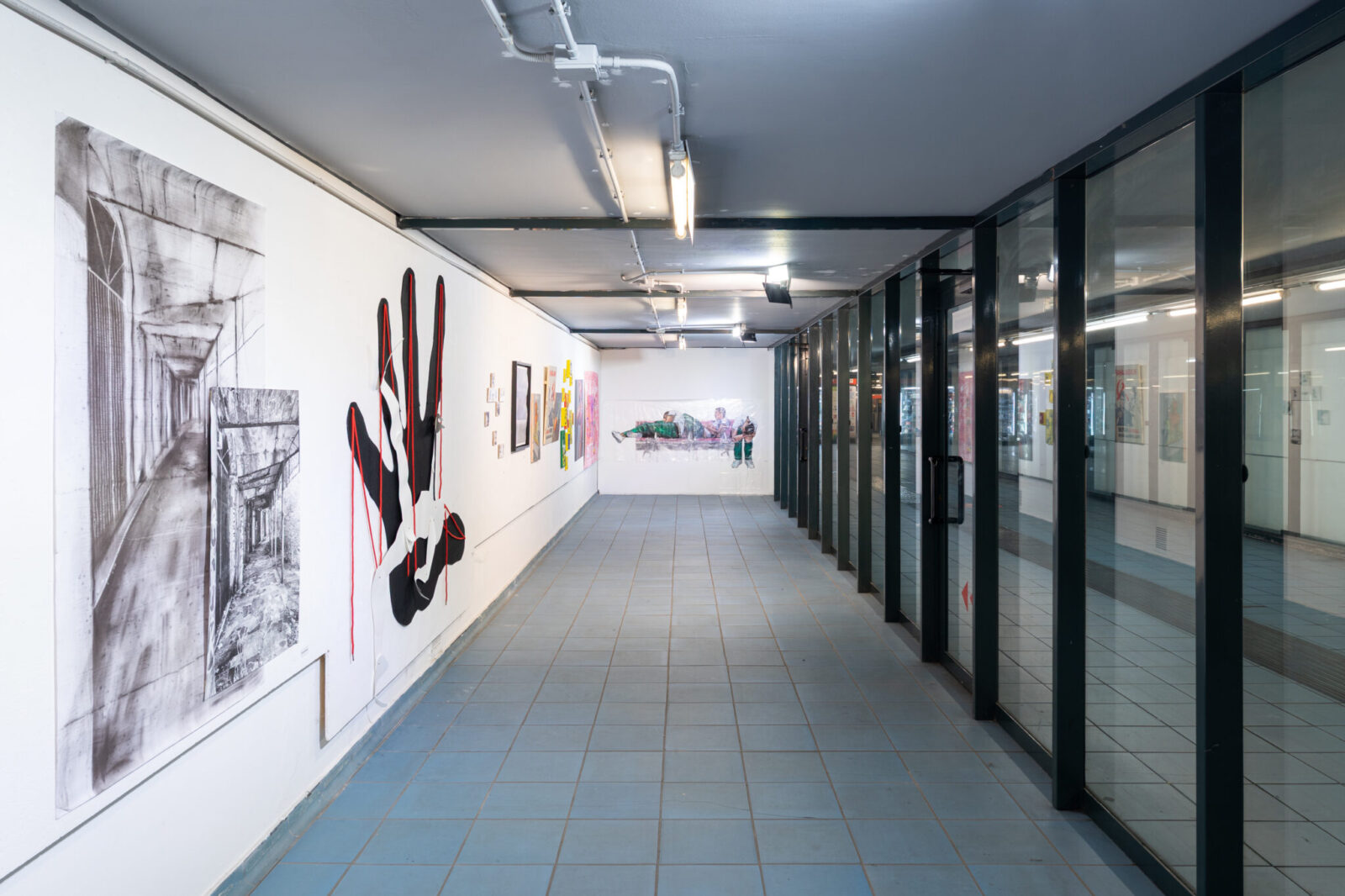
Propaganda is a real weapon against which it is difficult to defend oneself. Unlike other war tools, it affects not only the direct victim, but people as a whole. “Propaganda guides and directs without you realizing you are being led,” explained Barbara Nahmad, a professor of Techniques and Technologies of Painting at the Accademia di Belle Arti di Brera (Academy of Fine Arts of Brera) in Milan.
Nahmad asked her students to reflect on the meaning of propaganda, not as an abstract concept, but as a daily experience that is often invisible but central to contemporary history.
From this invitation, the Propaganda exhibition took shape. Inaugurated on Holocaust Remembrance Day, the exhibition is set up in the spaces of the Porta Venezia railway underpass in collaboration with the Artepassante Foundation.
Accompanying the exhibition is an analysis by Riccardo Notte, a professor of cultural anthropology at the Brera Academy. In his critical text, he reconstructs the thought and legacy of Edward L. Bernays, author of the 1928 essay Propaganda. According to Notte, Bernays not only observes the mechanisms of manipulation, but also teaches how to use them. His strategy is based on simplifying language and activating collective emotions. “A simple, direct, and well-packaged idea—better if summarized in a slogan or effective phrase—can guide desires, expectations, and hostility,” writes Notte.
This, he explains, is the power of propaganda. Propaganda offers an apparently clear reading of a complex world. It divides reality into clear categories of “good” and “evil,” indicating who is responsible each time.
Nahmad, a painter and the curator of the exhibition, explained that the works in the exhibition are heterogeneous in both language and format. There is no linear story, only a sequence of works resulting from individual reflection.
A rifle made of Lego bricks is presented as an almost harmless object. But it is precisely this contrast that makes the work ambiguous. What appears to be a game hides potential violence. The piece suggests that propaganda is not always threatening. It often takes the form of entertainment, consumption, and lightness.
Similarly, in a still life, an apple is placed next to a hand grenade, a pairing that eliminates any possibility of neutrality. In another work, a large black hand fills the wall. Red threads emerge from the fingertips and manipulate a puppet. This symbolizes the control exercised from above and the manipulation that remains offstage yet governs the movements.
On a large canvas, two young women with blurred faces are depicted in front of Milan Cathedral, one of the city’s most iconic landmarks. One of the women approaches the other and whispers in her ear. It is an intimate gesture, but in this context, it takes on a different meaning. Propaganda becomes a low voice, a suggestion that circulates in public spaces and is passed on through relationships of trust.
Together, the works convey recurring feelings of powerlessness and disorientation, and sometimes the desire to escape others’ gaze, said the curator. “I did not ask the students to provide answers, but rather to recognize that the problem exists,” Nahmad remarked. Her hope, she concluded, is that students will keep “the awareness of having developed critical thinking about the information they receive every day.”
Daniel Reichel
Translated by Alessia Tivan and revised by Matilde Bortolussi, students at the Advanced School for Interpreters and Translators of the University of Trieste, trainees in the newsroom of the Union of the Italian Jewish Communities – Pagine Ebraiche