
Piazza Santa Giulia: Eight Stones Honor a Forgotten Chapter from the Holocaust in Turin
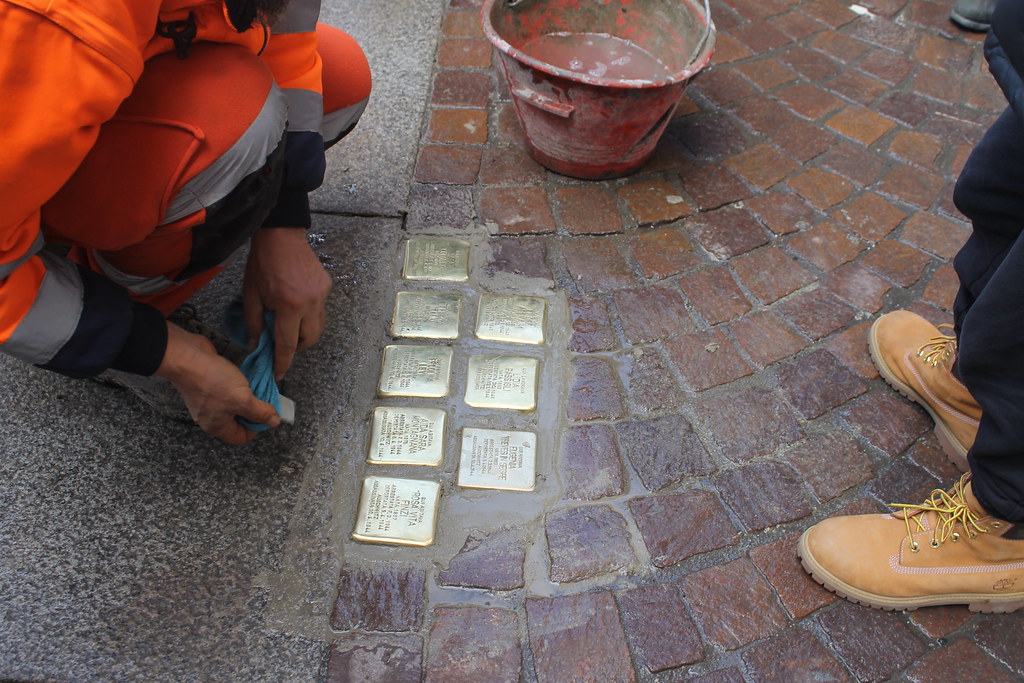
The Jewish hospice in Turin, which was located in Piazza Santa Giulia, no longer exists. It was bombed during World War II and demolished after the war. Another building replaced it. However, some Jewish lives were lost during the demolition: Aida Sara Montagnana, Rosa Vita Finzi, Teresita Teglio, Ercolina Levi, Sara Colombo, Eugenia Treves (later Segre), Lidia Passigli, and Ettore Abenaim. For a long time, these names were marginalized in public remembrance, but they are now honored by eight stumbling stones at 12 Piazza Santa Giulia, where the hospice once stood. “The case of Piazza Santa Giulia is one of the most upsetting chapters of the Holocaust in Turin, and it was rediscovered only a few years ago,” said Dario Disegni, president of the Turin Jewish community. “Six elderly and infirm women were deported. Each time we shift from sweeping history to the microhistory of families living next door, this tragedy becomes more tangible.”
The stumbling stones bring back their names and lives. The women, aged sixty to eighty, were mostly unmarried or widowed, in poor health, and in precarious financial circumstances. The hospice in Piazza Santa Giulia was the last place they chose to live. Sara Colombo and Ercolina Levi never married. Aida Sara Montagnana worked as a mender. Eugenia Treves was a knitwear worker. Rosa Vita Finzi was a widow. Teresita Teglio lived there with her husband, Moisé Segre. Also living there were Lidia Passigli, the hospice director, and Ettore Abenaim, the institution’s bursar.
After the July 13, 1943, bombing left the building uninhabitable, the hospice’s guests were transferred to other local institutions. A group was admitted to the Fascist Hospitality House on Via Como 140, now Via Ghedini. On December 3, 1943, twenty women were arrested from there and taken to the Le Nuove prison. Some were initially released and then rearrested in March 1944. They were transferred to the Fossoli concentration camp and then deported to Auschwitz. They were killed on April 10, 1944, the day they arrived. This episode has recently been brought back to attention by the research of the historian Nicola Adducci in the Turin prison archives and the work of Claudio Mercandino of the Italian National Association of Partisans (ANPI) section “Renato Martorelli.”
During the laying ceremony, the stories engraved on the stones were read one by one. Students from the Einstein Science High School gave voice to seven biographies. The students played a leading role in the research process, the results of which are presented in the book Nel vostro nome (In Your Name), published by Impremix. Edoardo Segre, Aida Sara Montagnana’s grandson, read her biography instead. “She never married and never had children. She was so good at mending that she was often asked to repair green billiard cloths,” reads her biographical note. “I think about the effort the Nazis put into looking for these women, who were elderly and lonely, without any bonds or roles, and destined to fade away. And yet, they were tracked down, arrested, and murdered,” Segre stated. “This story reminds us of one of the meanings of the Holocaust: the Nazi-Fascist attempt to wipe out an entire people.”
“It’s unusual to see eight stumbling stones all at once,” said Eva Vitali Norsa, the Stolpersteine committee representative for the Turin Jewish Community. “They form a choral narrative, giving back a face and an identity to one of the most intense events of the Turin Shoah, which has been left without a place or a voice for so long,” she concluded.
Daniel Reichel
Translated by Caterina Mansani and revised by Matilde Bortolussi, students at the Advanced School for Interpreters and Translators of the University of Trieste, trainees in the newsroom of the Union of the Italian Jewish Communities – Pagine Ebraiche.