
Righteous Among the Nations: The Nun Who Hid Jews in a Clinic
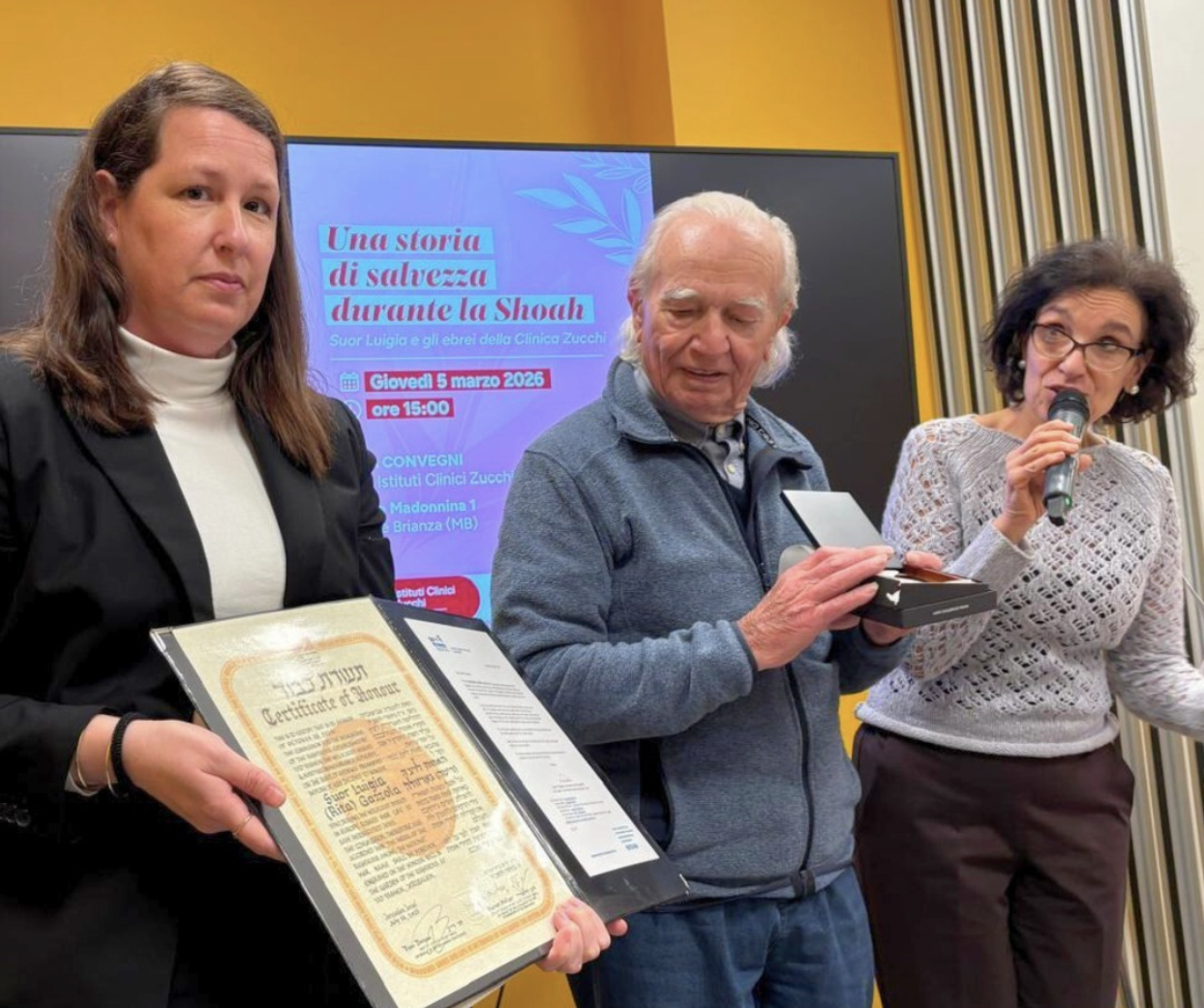
“I don’t remember exactly how we escaped. I was only ten years old, and I didn’t understand much of what was happening. But we found Sister Luigia, who was so much more than a nun to us.” With these words, 92-year-old Serena Milla recalled the woman who saved her, her mother, and her grandmother from deportation during the Holocaust. Her testimony was shared on March 5 at a ceremony held at the Istituti Clinici Zucchi (Zucchi Clinic Institute) in Carate Brianza, Lombardy. During the event, Sister Luigia Gazzola’s family received a medal and certificate of Righteous Among the Nations, awarded by the Yad Vashem Holocaust Memorial in Jerusalem.
The events date back to 1943. At the time, the Zucchi Clinic was a women’s health facility. Sister Luigia Gazzola, a nun originally from Altivole in the province of Treviso (Veneto), led the clinic as mother superior during the war.
The Milla family found refuge there after September 8, 1943. The Millas, Milanese Jews, had sought shelter in nearby Verderio to escape the anti-Jewish persecutions of the Italian Social Republic and Nazi raids. However, a betrayal led to the arrest of some family members. Serena’s father, Ugo, and her uncle, Ferruccio, were captured and deported to Auschwitz, where they were killed. The same fate befell her aunts Laura, Lina, and Amelia. However, Serena managed to survive, along with her mother, Lea, and shortly afterward, her grandmother, Nelly Coen Gialli. They found protection at the Carate Brianza health facility thanks to Sister Luigia Gazzola. “I don’t remember who took us to the clinic. I was very young. But there were other people in hiding, and for us, that nun became a point of reference,” Serena recounted.
To protect them from Nazi-Fascist roundups, the mother superior devised a simple yet risky solution. When the Nazis arrived, she would hide the Millas in the psychiatric ward of the clinic. “We were near the ward for the mentally ill because the Germans did not venture that far. They were afraid of the patients.” During inspections, the children were hidden in seconds. “When the soldiers came, Sister Luigia would hide the little ones under the sofa.” At other times, a young patient at the clinic would help her. Thus, Serena, her mother, and her grandmother remained protected until Liberation.
On April 25, 1945, news of the end of the war reached the clinic as well. “I remember the mother superior ringing the bell and shouting, ‘It’s over! It’s over!’ and all of us dancing and hugging each other.”
After the war, Serena returned several times to Carate Brianza to visit her and the other nuns. “She took great risks to protect us, and she didn’t just save the three of us; she saved many, many people.”
The March 5 ceremony was also attended by Mario Gazzola, a 90-year-old grandson of Sister Luigia, who helped reconstruct the story. “Being able to compare Aunt Sister Luigia to figures like Bartali or Perlasca, the Righteous Among the Nations, moves me and makes me very proud,” he said. Yet, the family rarely spoke about that history. “Aunt Luigia considered what she had done a simple duty. She said it was her obligation. She never sought recognition.”
Only shortly before her death in 1983 did she mention her actions during the war for the first time. “Two days before she passed away, she told me, ‘Mario, come visit me because I want to put you in touch with the witnesses.'”
Those words began a decades-long journey that was recently revived thanks to the research and efforts of writer Paola Fargion. Fargion was present at the ceremony along with Daniela Dana Tedeschi, president of the Association of Children of the Holocaust.
Translated by Caterina Mansani and revised by Elizabeth El Khoury, students at the Advanced School for Interpreters and Translators of the University of Trieste, trainees in the newsroom of the Union of the Italian Jewish Communities – Pagine Ebraiche.