
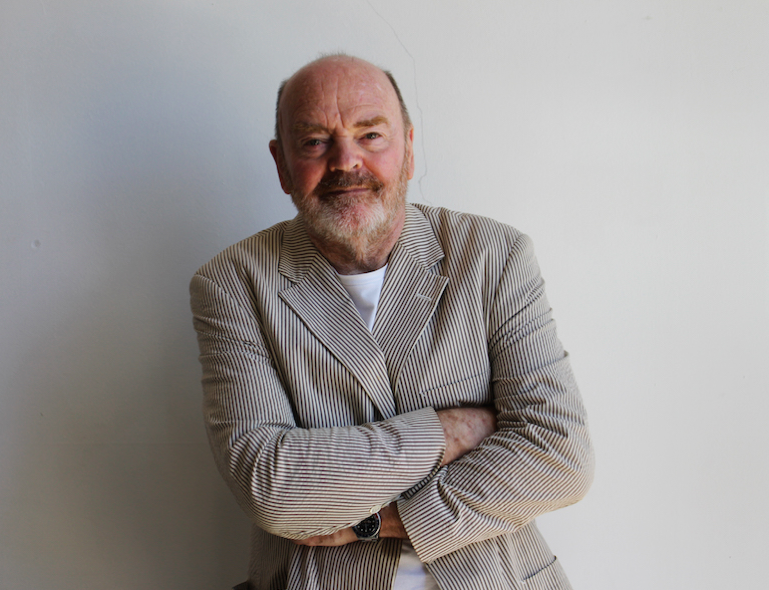
That night, under the surveillance of a Carabinieri officer, the antifascist Livio Goldschmied was allowed to leave his cell for a few minutes. It was the only time he saw his newborn son. Born on November 29, 1943, in Ivrea, Lombardy, the baby was named Adriano. This was a tribute to Italian engineer, entrepreneur, and industrialist Adriano Olivetti, the manufacturer of the Olivetti brand of typewriters, calculators, and computers. Goldschmied had a strong connection to Olivetti, who tried to help free him until the end.
“The only time my brother met my father was in prison,” recalled Diana Goldschmied, who is two years older than Adriano. This memory resurfaced as the family prepared to say farewell to Adriano Goldschmied, who died on March 30. He was 82. Adriano Goldschmied was an influential figure in the contemporary fashion scene. Ahead of his time, he was one of the pioneers who transformed denim into a global language of style. “Like my father, my brother was a man of great intelligence and extraordinary intuition. However, he did not want to talk about our family history. I think memory was working inside him, though,” Diana Goldschmied explained.
His father, Livio, who was of Hungarian Jewish origin, was from Trieste in northeastern Italy. Following the armistice between Italy and Germany on September 8, 1943, he sought refuge in the woods of Canavese, in Lombardy. The Nazis had occupied the area, hunting down Jews. His family was nearby. Someone, perhaps a midwife, denounced him and reported his hiding place. Livio was arrested in Vico Canavese on February 29, 1944, and incarcerated in Ivrea. “My mother did everything she could to save him,” said Diana. “Thanks to the Olivettis, a lawyer accompanied her to the German headquarters in North Italy. She repeatedly tried to free him, even using the mixed marriage card.” Her determination secured Livio the fleeting visit in which he met little Adriano. “My mother implored him to flee. “I can’t. Poor Carabinieri. Think what will happen to them if I run away,'” he answered in dialect.
From Ivrea, Livio was transferred to the Fossoli transit camp. He managed to stay in touch with his wife, Sofia, who was also trying to free him. Thanks to the Olivetti family, she obtained a release document. She really thought it was done. Yet, when she arrived in Fossoli, my father had already been deported.” Livio Goldschmied was killed in Auschwitz on August 2, 1944.
Adriano grew up never knowing his father. “I only have a memory of him. I’m sitting on the lawn leaning against a tree, and I see my father coming over with some toys. He picks me up, makes me jump, and we both laugh. That is the only image I have, whereas Adriano had none.”
For the family, the years after WWII are marked by loss and loneliness. The mother, Sofia, does not find a community to refer to; the grandparents die in 1948. “We felt very isolated,” said Diana. Despite her anguish, Sofia managed to give her children a sense of freedom. She took them to the Alps for extended periods of time. “We grew up in a state of wilderness. I feel that nature saved us.”
It was there that Adriano’s personality began to emerge. “He had something special,” Diana recalled, recalling an episode. “He was maybe eight years old. At a farmhouse near our home, the farmer’s children were building wooden boxes for apples. Adriano used to go ‘working’ with them. In a short time, Adriano reorganized the entire process. Everyone did their part like an assembly line, and the boxes were made much more quickly. One day, the father of one of those kids approached my mother on the street and said he should pay her for Adriano’s help. Even at that young age, he had such intuition. Whatever he committed to, he gave his all.”
Over the years, this ability translated into a new vision of the product and market. His concept of denim was rooted in the Italian collective imagination after World War I. “To us, they were the clothes of heroes,” Adriano said in interviews, referring to American soldiers. He transformed this image into an entrepreneurial vision, elevating jeans beyond their working-class origins and establishing them as a distinctive language of contemporary fashion.
“Adriano and I lead very separate lives,” Diana said. “I rediscovered my Jewish identity. He took a different path, but everyone carries the past within them.” Over the years, she reconstructed the family’s history by collecting documents, photographs, and testimonies. This led to the laying of Stumbling Stones, brass plaques set in sidewalks, in front of the house from which his relatives were deported. “It felt like a duty to me. They are meant to commemorate those who did not have children, especially. In a way, we made our loved ones real. We brought them back to us.”
Daniel Reichel