
Turin’s March to Remember Emanuele Artom
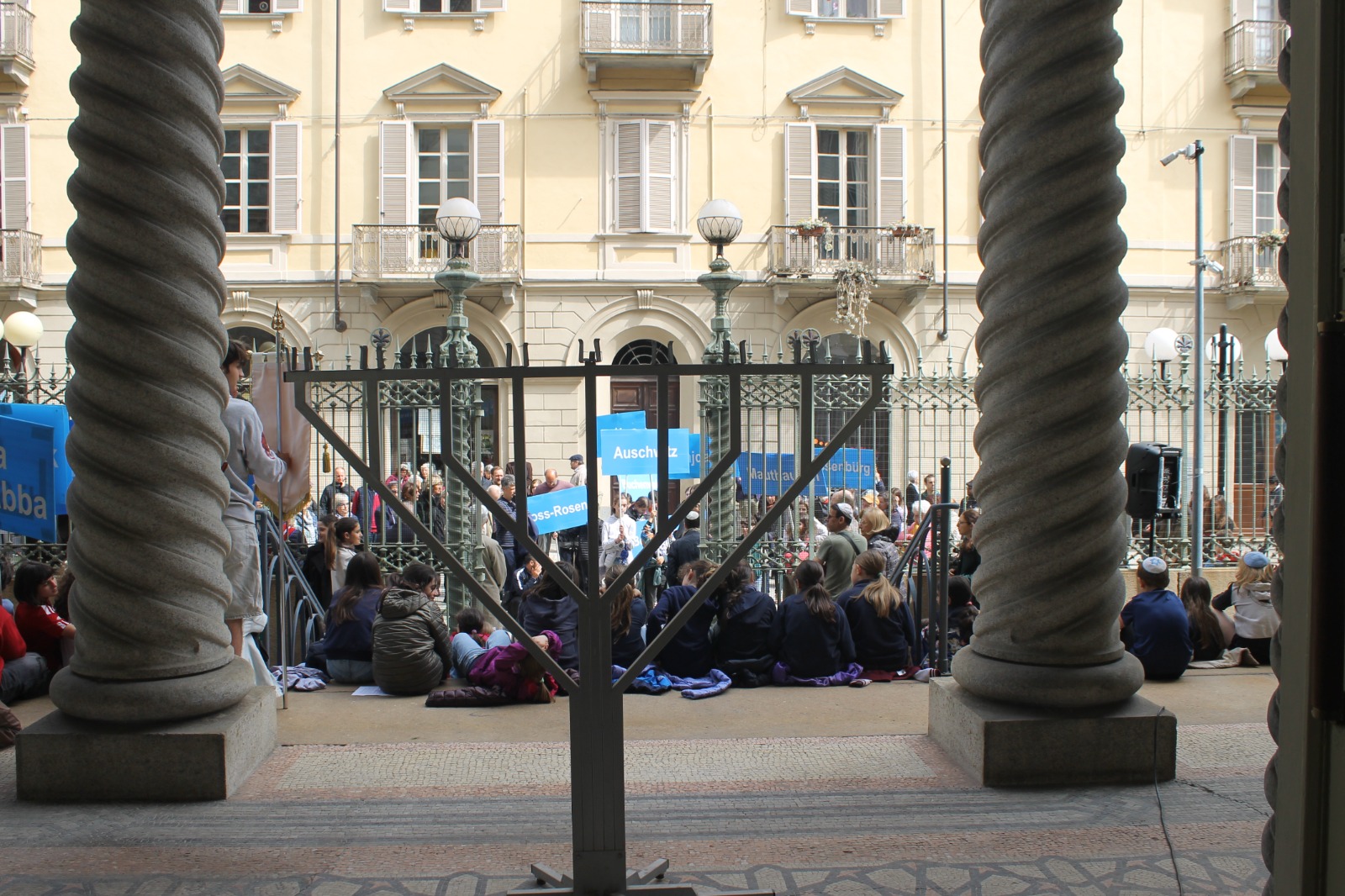
On April 15, a silent march set off from Platform 17 of Porta Nuova Railway Station in Turin, Piedmont, at 9:00 a.m. A banner at the front read: “There is no future without memory.” Following it were middle school students, teachers, and representatives of institutions, as well as members of the Jewish communities of Turin, Casale Monferrato, and Vercelli, along with associations and religious groups. The participants held white signs on a blue background bearing the names of Nazi-Fascist extermination camps.
The march was dedicated to Emanuele Artom and takes place every year around April 7, the day the young Jewish partisan was killed by Nazi-fascists in Turin’s Le Nuove prison in 1944. He was 32 years old. A historian and intellectual, Artom had joined the “Giustizia e Libertà” brigades, an Italian anti-fascist resistance movement. Captured on March 25 between Val Germanasca and Val Pellice, Artom was tortured for weeks in an attempt to force him to reveal the names of his comrades, but he never gave in.
This year marks the 82nd anniversary of his death. The organizers of the march — the Jewish communities of Turin, Casale, and Vercelli, together with the Community of Sant’Egidio — chose the theme “Dialogue, respect, and discussion for a common dream,” referencing the 80th anniversary of the Italian Constitution.
The march proceeded by the Jewish Community’s school, which is named after Artom, and concluded at Piazzetta Primo Levi. There, Dario Disegni, the president of the Jewish Community of Turin, spoke alongside representatives of civil and religious institutions. “Artom’s example and teachings are more relevant than ever in a world shaken by terrible wars and suffering,” said Disegni. He added that the Constitution was born “from the Resistance and the sacrifices of many partisans who gave their lives for justice, freedom, and equality among all citizens.” This demonstrates the direct connection between personal experiences like Artom’s and the establishment of the Italian Republic.
Disegni highlighted the role of schools and thanked students and teachers, as well as institutions, for participating in what he called “a fundamental event in the civic calendar of our city.” He also referred to Liberation Day. However, the Jewish Community will not participate in the April 24 torchlight rally because it coincides with Shabbat. Still, April 25 is “a fundamental moment in the long history of the Jewish community in Italy, which goes back more than 2,200 years” because it marked the restoration of rights following the shame of the 1938 racial laws and the Holocaust. This return was achieved, in no small part, thanks to significant participation in the Resistance: “More than a thousand Italian Jews joined partisan groups as fighters,” Disegni recalled. Many of their stories have long remained unknown. “While some, like Primo Levi’s, are well known, many others have been forgotten.”
Through years of research, historian Liliana Picciotto tried to fill this gap by reconstructing the biographies of Jewish Italian partisans. Their stories are now collected in the online project “Resisting Jews of Italy” on the CDEC Foundation’s portal. On April 26, the Turin Community will present this work at an event open to all citizens.
Translated by Elizabeth El Khoury and revised by Caterina Mansani, students at the Advanced School for Interpreters and Translators of the University of Trieste, trainees in the newsroom of the Union of the Italian Jewish Communities – Pagine Ebraiche.