
Turin Shows Solidarity After Eight Stumbling Stones Defaced
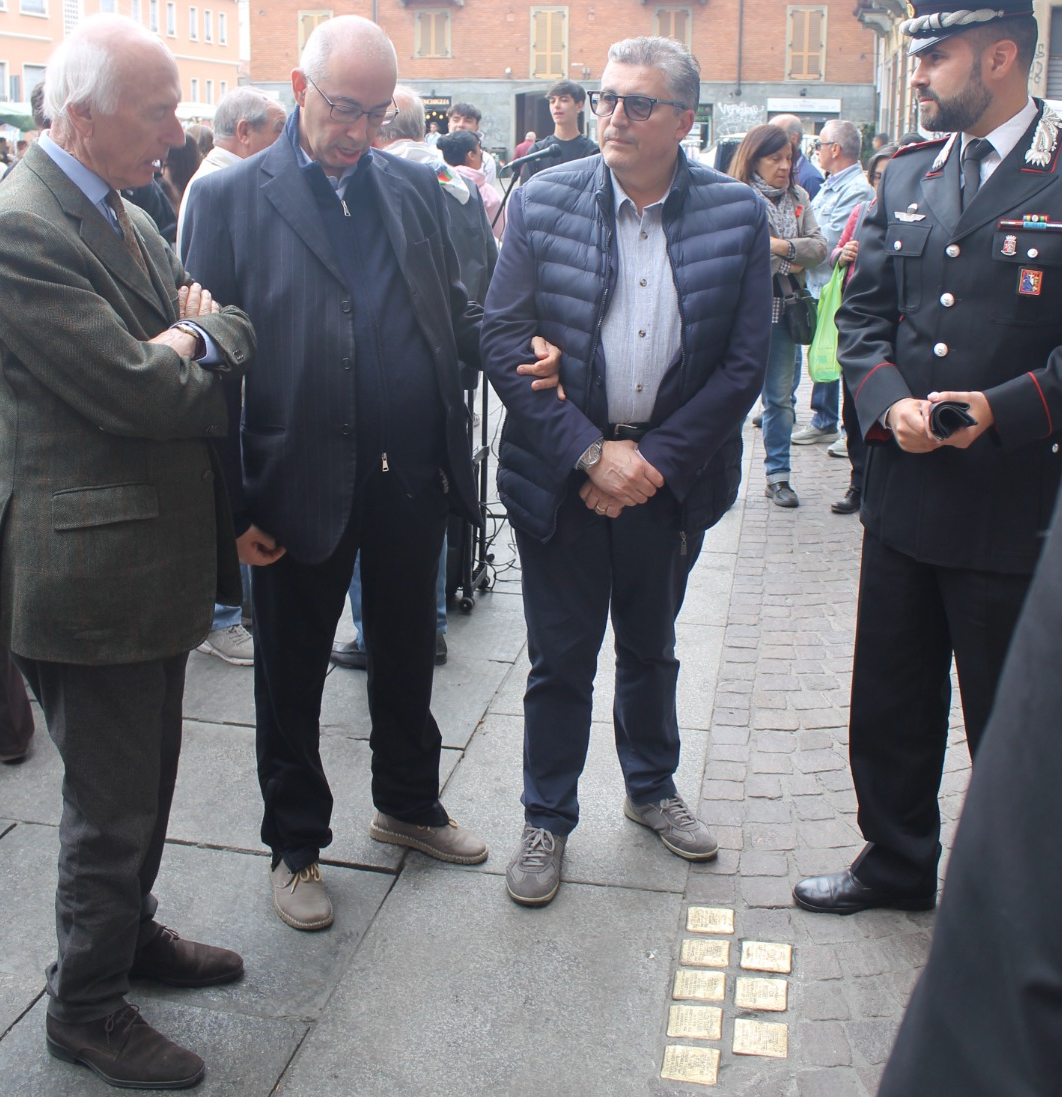
The night of May 1, unknown individuals defaced eight stumbling stones at 12 Piazza Santa Giulia in Turin by covering them with black paint. Installed three months ago, the brass plaques bear the names of six elderly and infirm women who were deported from the Jewish Hospital, formerly located in Piazza Santa Giulia, and killed in Nazi extermination camps. The names are Aida Sara Montagnana, Rosa Vita Finzi, Teresita Teglio, Ercolina Levi, Sara Colombo, Eugenia Treves (later Segre), Lidia Passigli, and Ettore Abenaim.
Turin’s response to this outrageous act was prompt. On Monday, May 4, local authorities, along with the National Association of Partisans (ANPI), institutions, and schools, organized a solidarity sit-in in front of the Stumbling Stones, which had been cleaned. “There was a large participation, especially from students attending schools in the area,” explained Dario Disegni, president of the Jewish Community of Turin. “It is a very important sign,” he noted, considering the many recent attempts to deny the Holocaust and the Resistance.
The eight Stumbling Stones in Piazza Santa Giulia recall one of the most distressing chapters of the Holocaust in Turin. On July 13, 1943, a bombing left the Jewish hospital uninhabitable, and its patients were transferred to other local institutions.
A group was admitted to the Fascist Hospitality House on Via Como 140, which is now Via Ghedini. On December 3, 1943, twenty women, ranging from 65 to 85 years old, were arrested there and taken to the Le Nuove prison. Some were initially released but rearrested in March 1944. They were transferred to the Fossoli concentration camp and ultimately deported to Auschwitz. They were killed on April 10, 1944, the day they arrived. “These were elderly and infirm women who were taken from a hospice and killed in an extermination camp. Disfiguring their memory is a particularly heinous act,” said Disegni, while noting that “we have been denouncing an exponential increase in antisemitism for a very long time.”
d.r.