
“Jules Isaac, a lesson for today”
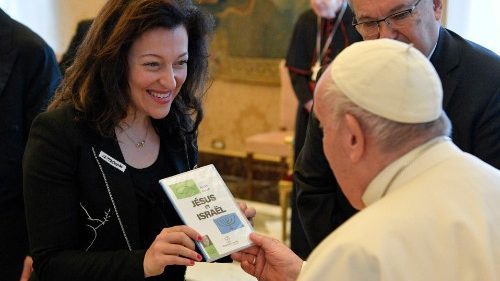
Si è svolta di recente in Vaticano una commemorazione di Jules Isaac, autore di “Gesù e Israele” e tra i pionieri del dialogo ebraico-cristiano. Durante l’udienza privata al papa è stato fatto dono di un audio libro in cui il pensiero di Isaac è interpretato dalla voce dell’attrice Guila Clara Kessous, artista Unesco per la pace e allieva di Elie Wiesel. Vi proponiamo la traduzione in inglese del nostro articolo realizzata a cura dello staff Unesco.
The Vatican commemorates a pioneer of the Dialogue “Jules Isaac, a lesson for today”.
In 1947, the French historian Jules Isaac was one of the promoters of the Seelisberg Conference, where Jews and Christians met and agreed on the “10 points of Seelisberg”, addressed to Christian leaders, to cease all forms of hostile preaching and narratives towards the Jewish community. This was a precondition for creating a climate of greater awareness and openness to dialogue, which would be the hallmark of his most famous book, Jesus and Israel, published the following year. A text of great impact: dedicated to his wife and daughter, both murdered in an extermination camp, the book has been read all over the world and has fueled a relentless struggle to give fruit to the hope of a better world. It was one of the seeds that will later give birth to the Declaration Nostra Aetate.
This was emphasized today by Pope Francis during a meeting with the leaders of the Amitié judéo-chrétienne de France association, of which Isaac was the founder. In his welcome address to a delegation from the other side of the Alps, which included various leaders and representatives of the French Jewish community, the Pope began by stressing the importance of this work, its programmatic force and its vision. A text, he said, “which is still relevant today and recalls the great spiritual patrimony common to Christians and Jews, wishing to encourage and recommend mutual knowledge and esteem”.
During the private audience, the Pope received an audio book in which Isaac’s thoughts are interpreted by the voice of the actress Guila Clara Kessous, UNESCO Artist for Peace and pupil of Elie Wiesel. Thirteen hours and fifteen minutes: that is how long you can listen to the book. Beforehand, Guila Clara Kessous tells Pagine Ebraiche, it represents seven years of research and work. “It was my mother who introduced me to Isaac’s work when I was a child. He was a figure who marked my growth and formation, pushing me to act in the name of Dialogue. The intervention of my teacher Elie Wiesel was then decisive: it was him who directed me towards this specific project, a year before his death.” A request that triggered “a profound process of identification, through which I tried to enter into Isaac’s heart and head”. The artist, who will also meet with representatives of the Jewish and Waldensian community in the coming days, explains that she has “great admiration” for this personality. Among his qualities, she underlines “his capacity for non-violent communication, his ability to manage emotions and to transform them into concrete results”.
An Almost prophetic figure who Guila Clara Kessous associates with her master, whose essay, Night, about his experience in the extermination camps, was interpreted by Kessous among other books. Night is a fundamental text for “understanding” Auschwitz and the Shoah. “He was a beacon, a light for all humanity. He also remains a reference for the way in which he elaborated his relationship with God. He never lost his faith, but at the same time he never stopped questioning it in relation to what had happened”.
Guila Clara Kessous, who speaks Hebrew and Arabic, works on many projects. One of them concerns relations between Israel and Morocco, which were recently “normalised” with the Abraham Accords. “A project is under development that will bring several Moroccan doctors to Israel. This will happen in April and will be, in its own way, a historic initiative. Concrete dialogue, living experience. An urgent need nowadays”.
Adam Smulevich